Monkeys and a Mannequin That’s Seen Some Things: A Panama Travel Story
- Doug Jenzen
- Mar 30
- 16 min read
Updated: 6 days ago
I feel like my Panama travel story is ultimately one of hope—a wild bet on the slim chance of finding that elusive person amid life’s endless detours. Yet, more than anything, it’s also a tribute to the fact that Guyana isn’t exactly built for seamless layovers. Instead, it’s like an extended intermission in a play you never auditioned for, where the absurdity of it all somehow makes the journey all the more unforgettable.
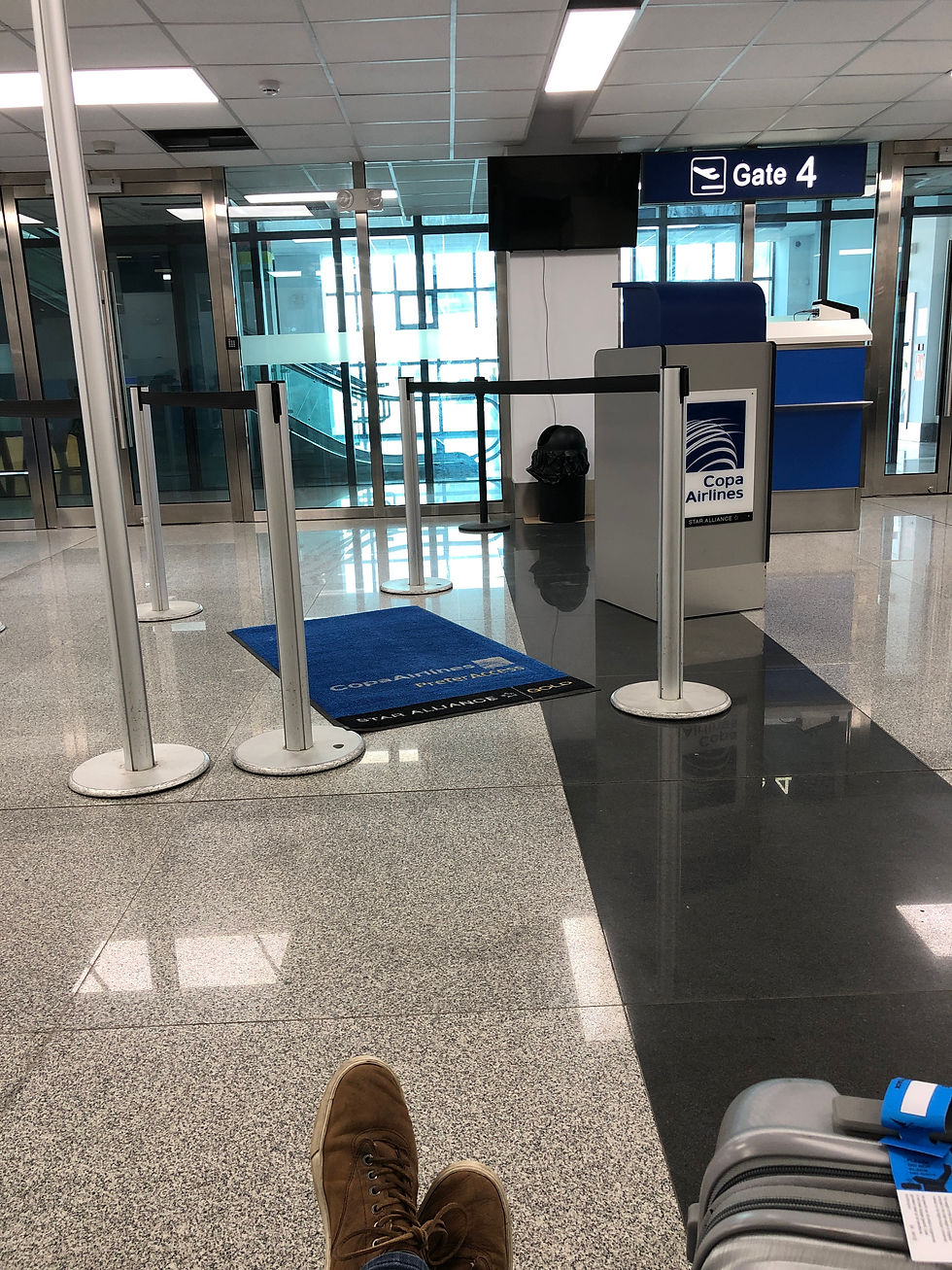
I packed my bags on the morning of July 3rd, 2019. The plan seemingly easy: fly Suriname Air back through Georgetown, then hop aboard Panama’s flagship carrier, Copa Airlines, to Panama City, where I was to rendezvous with the Brit. Theoretically simple was not reality.
There’s no such luxury as checking your bag straight through to Panama when flying through Guyana. Instead, I retrieve it in Georgetown and then, in a curious display of logistical acrobatics, re-check it—though not without a brisk promenade along a dirt path festooned with weeds, all under the bemused stares of locals who must have wondered if I’d mistaken the small airport for a major metropolitan hub. Once inside the ticketing area, I find myself marooned for four hours on a bench, left to ponder the absurdity of it all while reading Eat, Pray, Love and watching people wrap what appeared to be all of their personal belongings in plastic, bound for wherever they were heading.

At long last, my Copa Airlines inbound flight arrives, and I'm able to get my tickets and pass through security with the relief of one escaping a particularly dreary chapter of life. Of course, there’s no proper restaurant —only the tantalizing prospect of a $150 bottle of rum and a mysterious food kiosk by the gates. I settle on what appears to be a scone accompanied by sour cream and chive Pringles—a brunch that, if nothing else, signals my undying commitment to travel.

Soon enough, Copa Airlines announces boarding for the 3 hour and 45-minute flight to Panama City. I find myself pondering my “will they, won’t they” saga with the Brit, book in hand. Elizabeth Gilbert's words remind me that when life’s broken into shatters, one must grab happiness by its ankles and hope it drags you out of the mess. Hopeful, yet simultaneously exasperatingly impractical, much like my travel itinerary.
After finally finishing Gilbert's tome, I switch to a new book recommended by Amazon—a social media influencer’s manifesto beginning with “For those that can’t even.” I read on, only to abandon it entirely by the time we land, a silent nod to my growing affinity for the midlife reflections of Gilbert rather than the confounded ramblings of a Gen Z self-proclaimed raconteur.
Immigration in Panama offers its own brand of comedy: my luggage, for reasons known only to the cosmic forces, is not on the carousel but nonchalantly piled in the aisle of the airport's luggage carousel area. An Uber later, I reach Hilton Panama City where the Brit had supposedly arrived a couple of hours prior. At check-in, I’m greeted by a display of cookies and punch in honor of the 4th of July—a subtle, ironic reminder that while we once celebrated America’s independence from the British, here in Panama, the roles seem deliciously reversed. I'm meeting a British person too.
To my delight, I learn that we've been upgraded to a room that is a spacious haven complete with a view of both the city's skyline and the Pacific Ocean, with a sitting area, a walk-in closet, and even its own corridor. At the door, I pause, debating whether to knock or simply saunter into the room. A light tap yields no response; using the key card, I enter and find a trail of clothes leading to the bedroom—evidence that the Brit, overcome by exhaustion, had promptly discarded his attire in favor of a crash landing on the bed. Leaving a mess in his wake is something for which he's known for according to a previously conversation about his colleague's view of him.
After a week and a half of escapades through Trinidad and Tobago, Guyana, and Suriname, I suddenly realize that exhaustion is the ultimate travel companion. I hadn't realized how exhausting it is to be "on" 24/7 while traveling through remote developing nations on one's own. I decide the Brit's idea is a good one and take a much-needed nap, letting sleep sweep away the chaos of bureaucracy and culinary oddities.
Dinner later brings us to a restaurant serving high-end American comfort food—think biscuits and honey, but with top-shelf Panamanian rum and tres leches cake. It’s a refreshing change to wander through Panama City with someone who savors travel rather than clinging to familiar borders, a stark contrast to my past relationship, the person that I had been in Panama with previously.

Post-dinner, we retreat to the Hilton’s bar for a nightcap, mutually agreeing on an early night as we face a day trip to the San Blas Islands in the morning.
Panama’s history is as colorful as its tropical landscapes, woven from the rich traditions of its indigenous peoples long before European ambitions set foot on its shores. Among these, the Guna of the San Blas Islands—officially known as Guna Yala—have maintained a fiercely independent cultural identity, navigating the tides of colonialism and modernity with a sense of resilience. In recent history, while the rest of Panama has sprinted toward modernity with the construction of the canal and a vibrant cosmopolitan pulse, the Guna have quietly preserved their age-old customs, textile artistry, and self-governing traditions. Their enduring presence is a delightful reminder that beneath the veneer of modern travel, timeless traditions persist—like a cherished heirloom passed down. To visit the San Blas Islands today, you must be accompanied by Gana guides.

Morning finds us gathering sunscreen, mosquito repellant, and a change of clothes for our San Blas adventure. Our driver—communicating solely through a series of earnest hand gestures—herds us into a van alongside fellow travelers. A brief stop at a Walmart-esque grocery store sees us purchasing water, chips, and cookies, just in case the promised lunch turns out to be as ambiguous as our itinerary.
Back in the van, the Brit promptly dozes off. Left to my own musings on the white-knuckle ride over the Panamanian isthmus, I watch orchids cling to fences and modest homes peek from forested hills, reflecting on life’s perennial unpredictability. A nudge to wake the Brit—whose personal creed forbids sleeping outside conventional hours—earns a grumpy retort and leaves me feeling rather like an over-eager extra in someone else’s travelogue. A woman in front of me overhears the exchange and strikes up conversation. My assumption was that she was a guide translating for our driver to other passengers, but it turns out that she's not affiliated with the tour but evidently an impromptu polyglot. She shares that she's been to 60+ countries. Her tale of renting a car in Guatemala and charmingly defying extortion by the local police are delivered with a mix of humor and resolve that I can’t help but envy.

Finally, our van reaches a weathered dock where we board a boat with our newfound companion. The tropical sea breeze offers a momentary respite from the day's eccentricities. We dock on our first island—a set-piece straight out of a castaway film, complete with weather-beaten wood beams and palm fronds roofing. Here, we’re instructed to relax until lunchtime, all the while peering down into a giant fish tank in the middle of the building where the catch for each of our eventual meals are still swimming.
The morning slipped away on a grassy, beachy island where we lounged like iguanas sunning themselves but with beer, joining in on fellow travelers having a conversation on the beach about staying in a cabin on this island—each of us silently acknowledging that true relaxation here requires one to be its own entertainer. Between awkward small talk and the faint promise of serenity, we learned that, on such a diminutive island, boredom is just as inevitable as the occasional sunburn.

Lunch arrived (no longer alive) in the unassuming guise of fish and french fries, a meal that was both unexpectedly satisfying and a subtle nod to the island’s resourcefulness. Post-lunch, we boarded the boat for our next stop. While the Brit and our spicey Italian companion plunged into the cool depths to explore a shipwreck—a relic of maritime misadventure—I surrendered to the sun, finding solace in the pages of a book. Moments later, the Brit returned to the shore, promptly collapsing into an impromptu siesta beside me, as if sleep were the island’s only true souvenir.
Our next destination was a whimsical outpost in the middle of the sea, where the sand flirted with the water’s edge and the Caribbean warmth allowed us to wade with knees-to-waist-deep optimism. The return journey to Panama City was punctuated by an unexpected spectacle: a giant inflatable peacock pool float, so enormous that it commandeered the boat’s bow, rendering our forward view delightfully obscure. It was a finale that encapsulated the day’s surreal charm.

Perhaps it was the company, the weather, or the crystalline blue water reminiscent of an impossibly clean swimming pool, but the San Blas Islands revealed themselves to me as one of the most beautiful places on Earth—a hidden gem that one might never find without a touch of serendipity and a willingness to brave the curvy roads.
Back in Panama City, as the darkness crept in and our new Italian friend bid us farewell at the Hilton, exhaustion claimed us like an affectionate, if overzealous, travel companion. We collapsed, our souls worn from a day saturated with sun, sea, and the absurdities of adventure.

The next morning dawns bright and early—an absolute blessing compared to the pre-dawn chaos of the day before. As I shuffle to the coffee maker (which, contrary to the Brit’s teasing, a hotel room coffeemaker has never actually met its demise at my hands, only suffered numerous spills and overflows from its questionable maintenance), he quips that I must have a curse on hotel coffeemakers. The morning’s ritual provided a much-needed jolt accompanied by enjoyable calm morning conversation before our next escapade.
Another van—overflowing with an eclectic mix of characters, including an American cougar and her rather clueless younger companion (neither of whom had bothered with mosquito repellent, so I shared mine)—picks us up as we meander through Panama City into the storied Canal Zone once managed by the United States. After a brief at a roadside shack featuring peanuts and bananas—a clear nod to the wildlife we are about to visit—we arrive at a small dock to board a boat that, with its modest cover, looks more like a leisurely golf cart than the adventure vessel of our previous day’s exploits.
Our tour, charmingly dubbed the “Monkey Island Tour” by Barefoot Panama (my personal favorite among local operators), is something of a misnomer. Instead of one island, we’re whisked between several tiny isles scattered across Lake Gatun—a man-made lake birthed during the monumental construction of the Panama Canal, serving as a curious halfway point between the Pacific and Atlantic Oceans. These islands, like historical postage stamps, mark territories where different species of monkeys still reign. Smaller islets play host to Geoffroy's tamarin (also known as the Panamanian, red-crested, or rufous-naped tamarin), while larger, forested patches shelter black howler monkeys and sloths that move at their own languid pace.
Our first stop is an island renowned for its Geoffroy's tamarins, small primates that can live up to 13 years and are classified as near threatened by the IUCN—though their evident excitement at our arrival makes you suspect they think we’re rolling in snacks. The guide, with a mixture of earnest instruction and playful warning about “fat, unhealthy monkeys” (as if we were feeding them an overindulgent birthday cake), distributes small morsels of food. He explains that the monkeys are rotated among different islands to prevent any one group from becoming overly dependent on our offerings—a small conservation effort amid the tourist spectacle.

Once our boat nears the island, the monkeys make their grand entrance. The family of Geoffroy’s tamarins—primates the size of guinea pigs with tails three times their length and faces that seem delightfully extraterrestrial—leap from the trees onto the roof of our vessel, perhaps to ensure it meets their stringent safety standards, before alighting gracefully on deck. Ever the sport, the Brit extends his hand with a dainty chunk of banana, promptly attracting a nimble primate that darts over like a furry, four-legged missile on a mission, grabs the banana chunk, and makes a beeline back towards the forest to enjoy it's snack.
Once the family of tamarins has all had their turns on the boat, we move to the next island dock at an island inhabited by Panamanian white-faced capuchins. These capuchins, more robust and unmistakably less delicate than their Geoffroy’s tamarin cousins, arrive with a soft “thud” that seems to punctuate our boat ride. I find myself more of an observer than a participant during this feeding session, content to snap photos of the Brit, smiling at providing bananas for our primate brethren, who concentrate deeply to peel as if they are trying to figure out a math problem. It’s a bittersweet tableau: here, in stark contrast to their cousins on Trinidad—who teeter on the brink of extinction—and those in Georgetown, trapped in enclosures that wouldn’t suit a rodent, these capuchins appear the healthiest. Yet, I can’t help but muse on the irony that, despite their apparent prosperity in the tourist-fed environment, one can hardly envision a scenario in which any of these monkeys truly benefit from our intervention.

After our primate rendezvous, the boat meanders through the calm expanse of Lake Gatun, flanked by lush freshwater vegetation, until we dock at an indigenous community home to the Embera-Wounaan. This group, whose ancestors have inhabited the borderlands of Colombia and Panama for generations, now live in a curious blend of tradition and modernity. Solar panels adorn their elevated homes, the head of the community wields a cell phone (for coordinating tourist visits), and, in the distance, a young girl belts out “Let It Go” from Frozen—a charming testament to the global reach of pop culture, courtesy of the local school system.
A male Embera-Wounaan guide then escorts us through the rainforest, regaling us with tales of traditional plant uses. These are the very same botanical wonders that, back home, are relegated to Home Depot’s decorative plant section—an ironic reminder of how disconnected we’ve become from nature’s practical wisdom. Our excursion concludes with the women of the community performing an “Eagle Dance,” an event reserved for special occasions so that, as our guide jests, they’re not always putting in their best effort. Amid the dance, local artisans offer baskets and other handcrafted wares for sale. I find myself drawn to a flat basket, its surface stitched with a charming turtle motif—a small souvenir to remind me of the delicate balance between tradition and modernity that defines this captivating corner of the world.


Post- "Monkey Island" / Embera-Wounaan tour, the Brit and I head to the ruins of Panama Viejo. Founded in 1519, Panama Viejo was the first European settlement on the Pacific Ocean —a glittering outpost for Spain’s colonial ambitions. But like most things built on plunder and hubris, it didn’t end well. In 1671, the infamous pirate Captain Henry Morgan (a man whose name now adorns bottles of rum and inspires poor life decisions) swept through the city, leaving behind smoldering rubble and perhaps a lesson about what happens when you flaunt too much gold in a world full of opportunistic marauders. Today, the ruins play host to a different kind of population: tiny long-tongued bats reminiscent of French bulldogs that flit through the crumbling archways at dusk, and insects that pollinate the orchids that cling to the trees as if history itself left them behind as an apology. It's really the only place where you can find wildlife like this around Panama City as much of the flora has been plundered in the same way that gold was in years passed. The city was never rebuilt, and instead, its bones were left to bake under the relentless Panamanian sun—a sort of ancient Instagram filter for modern-day history buffs and heatstroke victims alike.


Panama itself has always been a country caught between worlds, a narrow isthmus where empires, cultures, and dubious geopolitical intentions collide. Long before the canal redefined global commerce, indigenous peoples thrived here, trading and connecting the continents long before Europeans arrived with their diseases and divine mandates. Post-independence, Panama was briefly part of Colombia until 1903, when it broke away with a nudge (read: full-blown intervention) from the United States. The canal, completed in 1914, became both Panama’s lifeblood and its bargaining chip—turning this sliver of land into a linchpin of global trade, but also a nation constantly negotiating its own sovereignty. Standing in the shadows of Panama Viejo, it’s easy to imagine the echoes of those negotiations still hanging in the thick tropical air, reminding us that history, like humidity, tends to stick around.

Deciding that our spirits—and possibly our core body temperatures—need a lift, the Brit and I hop into an Uber and head to Casco Viejo, the second iteration of Panama City built after Captain Morgan’s little arson spree. As we wander through the maze of beautifully restored colonial buildings, we pass a storefront window that stops me in my tracks. Staring back at us is a mannequin that looks like it’s survived one too many Panamanian carnivals—decked out in a neon beaded necklace, a sunhat that’s seen better days, and oversized sunglasses reflecting a world it’s clearly over. If Cher and Keith Richards had a love child and left it in a souvenir shop, this would be it. We tear ourselves away and eventually land at Bajareque Coffee House and Roastery, a charmingly unpretentious spot tucked inside a narrow colonial building that seems to lean ever so slightly under the weight of its own history. This cozy roastery is the Panama City outpost of the renowned Elida Estate, home to the coveted Café Geisha—a coffee so prized and absurdly expensive that it’s practically the Beyoncé of the bean world. And while sipping it here is slightly more affordable than auction prices that can rival a used car, it’s still enough to make us question whether enlightenment should come with a price tag. But with each delicate, floral sip, it’s hard to argue—it tastes less like coffee and more like a fleeting promise that life can, in fact, be both complex and beautiful.

Back at our home base—the Hilton Panama City—we indulge in a rejuvenating nap and a much-needed shower before setting out for Donde José, ranked among the top 50 restaurants in Latin America (and by extension, most of the Western Hemisphere). The Brit, ever the planner, had secured reservations months in advance to guarantee us a spot at what is essentially the region’s equivalent of a Michelin-starred establishment.
We hail an Uber that whisks us through the shadowy streets of Old Panama, a neighborhood where beautiful historic buildings flirt with dereliction, each block a study in contrasts—one moment you’re passing a run-down relic, the next, a property that looks promising enough to consider a second home. The Uber eventually drops us off on a block devoid of any signage, leaving us to wonder, “¿Dónde está Dónde José?” Armed with Google Maps and a healthy dose of skepticism, we eventually stumble upon a nondescript door tucked away at a corner.


As we notice people emerging from a building that appears, by all accounts, to be closed, we ask if they were departing Donde José. A casually affable doorman greets us, inquiring if we’re here for Donde José, before politely opening the door. Our curiosity is rewarded with a stroke of luck: the owner is indeed José, and in the absence of any flashy signage, the restaurant’s unassuming name speaks for itself.

At Donde José, guests embark on an intimate culinary journey that delves deep into Panama’s rich cultural tapestry. Walking into the restaurant, the Brit and I notice that the restaurant’s unmarked entrance is just one of the elements that add an air of exclusivity as the cozy space seats just 16.
Chef José Olmedo Carles crafts a tasting menu that evolves with the seasons, spotlighting indigenous ingredients sourced from local farmers. Each dish is a narrative, weaving stories of Panama’s history and biodiversity.
We immerse ourselves in the experience—imagine a “Caribbean Flow” course featuring a trio of bite-sized appetizers that pay homage to the Caribbean influence in Panamanian cuisine, each plate a mini theatrical performance of flavors. At Donde José, the theatrics reach a fever pitch when a waitress arrives with what could only be described as a toaster over coal and flames, effectively “searing” our food in front of our very eyes.
By night’s end, with our bellies full and our hearts content, we step out of that unmarked restaurant and into the warm humid Panamanian spring evening, then hail an Uber back to the Hilton—and our ginormous room. The Brit catches an early flight back to New York, leaving me with a free day in Panama to sleep in, lounge by the pool during the non-rainy hours, and catch up on work. The next morning, I am off to San Francisco for a conference.

That trip marks the final chapter of my travels with the Brit. Our “will they, won’t they” saga resolves itself into a simple truth: they simply will not. Yet, I was compelled to chase that which makes life worth living—even if it meant meeting a charming Brit on several island nations after first encountering him on a Caribbean beach the year prior.
Looking back, this moment feels like the end of an era—a farewell to my meet-cute turned travel partner filled with shared interests and laughter. But maybe a right person at the wrong time is simply a sign that timing is everything, and people appear when we most need them. The Brit made my life special, if only for a fleeting, bittersweet moment in a very special place.
I like to think that even as we grew apart, we grew in ways that only shared adventure can foster. There's a line in one of my favorite movies, Before Sunset, "I guess when you're young, you just believe there will be many people with whom you'll connect with. Later in life, you realize it only happens a few times." While genuine connections are few and far between, I now smile at the unexpected beauty and absurd humor that made those days unforgettable. After all, travel isn’t just about reaching a destination—it’s about collecting offbeat memories that remind us how exquisitely unpredictable life can be, tiny unplanned moments, quite mornings over coffee, the incredible restaurant that you stumble upon, and the sunset from the spot you didn't even know existed. Our trip to Panama, with its coffeemaker mishaps, van rides, primate parades, and cultural excursions, stands as a vivid reminder that history, biology, and human ingenuity intermingle in the most unexpected ways—each stop on the journey offering a story worth telling.


Comments