Suriname: Drug Smuggling and a Singing Russian Priest
- Doug Jenzen
- Mar 10, 2025
- 13 min read
Updated: Dec 10, 2025
Who you travel with matters, except when it doesn’t.

United Airlines has a tagline that claims something to the effect of “Who you travel with matters as much as where you’re going.” This is a sweet sentiment, assuming one is traveling with a well-adjusted, gainfully employed companion who possesses both a sense of humor and the ability to carry their own luggage.
But what if you’re traveling alone?
If the ad execs at United are to be believed, solo travel is little more than a sad, empty trudge through foreign lands, an existential exercise in longing. This is, of course, nonsense. Solo travel is liberating. You eat when you want, go where you please, and never have to hear someone complain about their blistered feet. But every now and then, it does make you wonder if a buffer person would improve the experience—like when your driver hits a woman carrying a baby.
Between an onboard medical emergency that nearly forced our plane to land in the middle of nowhere, an alarming amount of trash floating through the Amazon, and, yes, the aforementioned vehicular baby strike (which, somehow, miraculously, left both mother and child unharmed), I find myself wondering if I’ve made a series of poor life choices.
At the very least, I’ve made a poor itinerary choice.
I’m sitting in Georgetown’s tiny but surprisingly new airport, staring at a group of Asian men with clipboards who don’t speak English. Based on my limited knowledge of geopolitics and a lifetime of bad assumptions, I decide they must be Chinese, here as part of some grand infrastructure investment. It’s a weird sight in South America, but at this point, nothing really surprises me anymore.
I board my flight to Paramaribo, Suriname, via Port of Spain, Trinidad. It turns out that Trinidad does not handle international transfers efficiently, or possibly at all, as I am forced to exit through immigration, collect my bag, and re-enter the country for a layover that lasts all of three hours.
“How long are you staying in Trinidad and Tobago?” the immigration officer asks.
“Three hours,” I say. “I’m in transit.”
He looks at me like I’m an idiot, which is fair.
Once I’m through, I find the only airport bar, order a whiskey, and debate whether I have time to escape to Port of Spain before my next flight. Given my luck so far, I decide against it. No need to add accidentally gets detained to the trip’s already eventful itinerary.
Eventually, I board Surinam Airways. The flight is mercifully uneventful, and we land in Paramaribo, formerly known as Dutch Guyana. I had hoped Suriname would be more polished than Guyana, given its ties to the Netherlands and the general orderliness of the Dutch Caribbean territories I’ve visited. But hope, as it turns out, is a dangerous thing.
We deplane on the runway. A massive KLM 747 sits in the distance, looking both completely out of place and entirely logical at the same time. It seems ridiculous to fly a plane that size from Amsterdam to a country this small, but then again, I have never met a Dutch person who wasn’t up for a good adventure.

Inside, the arrivals line is long and slow. As I stand waiting for my visa on arrival, I hear a conversation in an American accent behind me. I turn slightly, catching a glimpse of two young women with the distinct energy of Pacific Northwest lesbians. They are, as far as I can tell, the only other Americans in this airport.
I hesitate for a moment, debating whether or not to engage. I’ve been traveling solo for days and could use some human interaction, but small talk is always a gamble.
“Where are you from?” I finally ask, hoping I don’t sound like someone who’s about to kidnap them.
“Portland,” one of them says. “We go to the University of Oregon.”
The other one looks like she would rather be anywhere else.
Trying to keep the conversation alive, I mention that I’ve been hopping around the Caribbean and just came from Guyana. “You’re the first Americans I’ve run into,” I add, attempting small-town friendliness.
“How was that?” the chattier one asks.
I pause. “It was… uh… interesting.”
This is, apparently, the wrong answer.
I try to elaborate, explaining that the tourist infrastructure in Guyana is still developing and that I felt like I stuck out—especially when I was made to sit at the very front of a boat down the river, towering over everyone else like some kind of colonial figurehead.
They shift uncomfortably. The quiet one looks deeply uncomfortable. I begin to wonder if they think I’m racist, if I should clarify that I’m not, or if clarifying that I’m not would somehow make things worse. I decide to do nothing, which, as always, is the safest bet.
We stand in silence for the next fifteen minutes.
Eventually, I reach immigration, buy my visa, collect my luggage, and find my driver. I am so ready to be away from self-righteous college students.
Like Guyana, the Suriname airport is a former military base inconveniently located in the middle of nowhere. Also, like Guyana, my itinerary has already changed.
The goal of this trip was simple.
1. See a leatherback turtle lay eggs on the beach.
2. Visit French Guiana, the only South American country still part of Europe, where people presumably enjoy pain au chocolate while mocking the rest of the continent.
3. Explore historic downtown Paramaribo, a UNESCO World Heritage site.
Out of these three, only one will happen. And given how this trip is going, I wouldn’t put money on the turtles.
I awake the next morning, the equatorial sun already asserting its dominance, and head to the designated meeting point near my hotel. As I navigate the streets, I’m immediately struck by the juxtaposition of beautifully restored Dutch colonial buildings standing proudly next to structures overtaken by nature, their facades succumbing to creeping vines and the relentless march of time. This stark contrast piques my curiosity.


Suriname’s history is a tapestry woven with threads of colonial ambition and cultural convergence. In the 17th century, the Dutch, eyeing the fertile lands of this region, established plantation colonies along its rivers, cultivating sugar, coffee, and cocoa. The labor-intensive nature of these plantations led to the tragic importation of African slaves, whose resilience and resistance gave rise to Maroon communities—escaped slaves who formed independent tribes in the dense rainforests.
The capital city, Paramaribo, bears the architectural legacy of this colonial past. Its Dutch colonial buildings, characterized by distinctive gable roofs and wooden structures, earned it the designation of a UNESCO World Heritage site. Yet, as I observe, this heritage stands at a crossroads between preservation and decay.
Eventually, I meet my guide for the day, an ethnically ambiguous man whose vibrant blue hair adds a modern splash to the historical backdrop. We embark on a leisurely stroll through Paramaribo, his enthusiasm for the city’s heritage evident in every step.

A standout structure captures our attention: the Cathedral of St. Peter and Paul, renowned as the tallest wooden building in the Americas. Constructed entirely of Surinamese cedar in the late 19th century, this neo-Gothic cathedral showcases intricate woodwork, vaulted ceilings, and towering spires. It’s an architectural marvel that, surprisingly, remains largely unknown outside Paramaribo.

Impressed by the city’s charm, I can’t help but voice my concern about the dilapidated buildings. Some structures, once grand, now seem on the verge of collapse.
The guide sighs, “There’s a developer,” he explains, “who refuses to adhere to UNESCO’s preservation standards. By leaving doors and windows open, he allows the elements to slowly destroy these buildings. It’s eroding the historic charm of the city.”
This deliberate neglect strikes me as a profound loss. Suriname’s history is intertwined with that of New England through the colonial trade networks of the 17th and 18th centuries. Suriname’s sugar, molasses, and rum were exchanged for New England-made products like salted fish and lumber, fueling both economies.
Moreover, Suriname was part of a significant historical exchange between the Dutch and the British. In 1667, under the Treaty of Breda, the Dutch ceded control of New Amsterdam (later New York City) to the British in exchange for retaining Suriname. At that time, Suriname’s thriving sugar plantations were considered highly valuable. This treaty marked the end of the Second Anglo-Dutch War and solidified British control over what would become one of the most important cities in North America. Meanwhile, Suriname remained a Dutch colony until it gained independence in 1975, reflecting the enduring impact of this colonial-era negotiation.
We walk passed a mosque and Jewish temple, quiet Nextdoor neighbors as opposed to conflicts in other parts of the world. Suriname’s Jewish community maintained cultural and trade ties with Jewish communities in New England during colonial times, Meanwhile, Muslims from other Dutch colonies made their way to Suriname. All of this reflecting the complex network of commerce and migration during the colonial period.
As we continue our tour, I reflect on the delicate balance between progress and preservation. Paramaribo’s architectural heritage is not just a testament to its past but also a foundation for its future. Ensuring that future generations can experience this unique blend of cultures and histories requires a collective commitment to safeguarding these structures.
The guide’s passion offers a glimmer of hope. Perhaps, with continued advocacy and awareness, Paramaribo can retain its historic charm while embracing the future.
There’s the Surinamese White House, in a neighborhood called Onafhankelijkheidsplein, because Dutch.

Venturing into a traditional market, my guide—whose blue hair could rival a tropical parrot—advises against photography, citing concerns over witchcraft. I nod, grasping the gist of his Dutch-to-English translation, and decide that discretion is the better part of valor. At one stall, I notice crudely fashioned wooden cups and inquire about their purpose. “The traditional people believe you won’t get malaria if you drink from them,” he explains. I purchase one, fully intending never to test its efficacy, preferring my pharmaceuticals—which, according to a British doctor, may come with a side of declining mental health.
As we stroll through Paramaribo, it becomes evident that this city is a better-preserved colonial enclave than Boston or New York. Here, history wasn’t bulldozed by skyscrapers but stood resilient until society recognized the value of preservation. So, here we are.

The skies open up, and we huddle under his umbrella in a futile attempt to stay dry. Eventually, I brave the deluge alone, returning to my hotel only to discover that my next day’s tour to French Guiana has been canceled due to flooding. The tour company also suggests canceling my leatherback turtle excursion, noting that no turtles have been spotted in days and that I’m the sole participant. Once again, I’ve wired money to a foreign tour operator, only to face cancellations. They offer a late-night Amazon jungle tour to see bugs and snakes—neither of which are my cup of tea. I propose paying extra for the turtle tour, the primary reason for my journey to this hard-to-reach country, and they agree.
With two unscheduled days, I decide to tackle work emails—a decision I soon regret. Coordinating a last-minute silent auction for my nonprofit’s gala, just three weeks away, becomes a monumental headache, affecting everyone from graphic designers to accountants. While I strive to be gracious to well-meaning supporters, organizing a silent auction in California from Suriname isn’t how I envisioned spending my hard-earned time off.
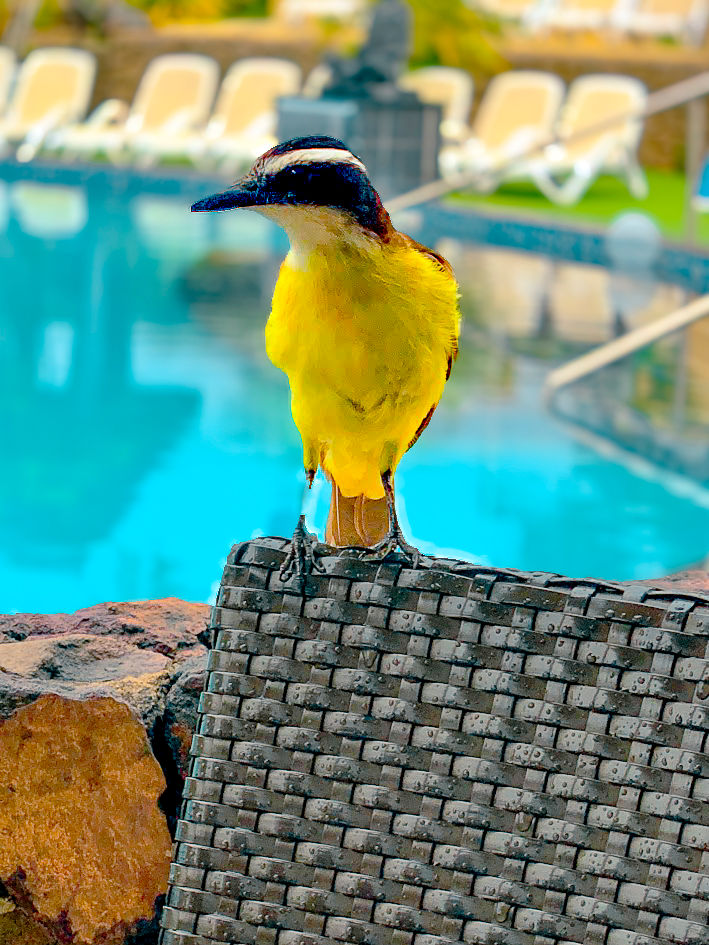
As I open my laptop poolside, a vibrant yellow bird lands on the chair across from me. Stunned, I think, “You’re a fearless little fellow, aren’t you?” I manage to snap a photo of this curious creature as it eyes my laptop and beer. Its bright plumage contrasts beautifully with the aquamarine pool, its dark head and black eye adding to its striking appearance. California doesn’t boast many brightly colored birds, let alone one as vivid as lemon meringue pie against a newly built hotel’s blue pool. After my new friend flies away, I search online and discover that Suriname’s national bird has paid me a visit, perhaps hoping for a stray French fry but finding only Microsoft Outlook and its annoying email chime.
The rain returns, prompting me to retreat to my room and work until nightfall. Later, I dine downstairs, seated next to a man engrossed in a phone call about oil equipment and local training. His frustration is palpable as he questions the value of their efforts. “I’ll have another beer,” he calls to the bartender after hanging up. I empathize with him and with the fragile rainforest likely affected by his company’s endeavors. “I’ll have another beer too,” I chime in, and order barbecue on the bartender’s recommendation—a surprisingly delightful choice at the Paramaribo Courtyard by Marriott. After a tame yet stress-filled evening, I retire to my room, hoping tomorrow brings better fortunes.
The following day unfolds in a familiar pattern of work until late afternoon, when my turtle biologist guide arrives at the hotel to collect me. Leatherback turtles, those elusive mariners, prefer the cover of night to grace our shores. My guide’s vehicle—a diminutive car reminiscent of a bygone Honda CRX—bears the marks of time and a backseat cluttered with assorted belongings. He mentions that the tour company has found another participant to join us.
Anticipating the unpredictable weather, I request a stop to purchase a poncho, recalling yesterday’s unscheduled drenching. He agrees, albeit with a hint of reluctance, and we proceed to collect our fellow traveler.
The new addition to our expedition speaks minimal English and lacks any knowledge of Dutch. Nevertheless, our guide identifies him as a Russian priest. We make a brief stop at what appears to be an army surplus store, where I acquire an olive-green poncho emitting an aroma akin to a plastic bag forgotten in a garage for years. Back in the car, I take the rear seat, deferring to the priest. This arrangement necessitates our guide raising his voice over the ambient road noise to communicate, given the priest’s limited comprehension. Our journey includes a pause at a local eatery, where the guide leaves us momentarily to procure dinner, returning with a bag containing three boxed meals.

Our guide, whose appearance suggests Middle Eastern heritage, speaks nearly flawless English with an American accent—a linguistic skill he attributes to self-education through music and films. Currently, he is pursuing graduate studies in herpetology, focusing on turtles.
We arrive as a narrow motorboat approaches us on a river so expansive it resembles an ocean. A quick check on Google Maps reveals we’re navigating toward the confluence of the Suriname and Commewijne Rivers—the former originating from the depths of the Amazon rainforest, the latter flowing from the east. The sheer volume of water, a testament to rainfall unimaginable to a Californian accustomed to perennial droughts, is staggering.

Our destination is a lagoon, separated from the Atlantic Ocean by a mere sandbar. The guide outlines our plan: a preliminary walk while daylight lingers to familiarize ourselves with the terrain, followed by dinner aboard the boat, and culminating in a nocturnal beach walk in hopes of witnessing a leatherback turtle nesting.
He points out depressions the size of Volkswagen Beetles—evidence of recent leatherback nesting activity. We also encounter crabs, opportunistic predators with a penchant for turtle eggs. It’s sobering to learn that only about 1% of hatchlings reach adulthood, a decline from the previous 3%, due to both natural predators and human-induced threats.
After our initial beach exploration, we return to the boat, relocate to a nearby spot adjacent to a tree, and partake in the dinners our guide procured—sandwiches. I remove the lettuce and tomatoes, consuming the ham and cheese with cautious optimism regarding potential bacterial hazards from improperly washed greens. Given my impending departure from Paramaribo the following day, the prospect of gastrointestinal distress during air travel is less than appealing—a recurring concern in my journeys.


Night falls, and with it, my last hope of seeing a giant leatherback turtle lumbering onto the beach like some prehistoric goddess of fertility. The guide, the Russian priest, and I are on a boat heading back to the beach.
Halfway there, the priest starts singing. Loudly. In Russian.
The guide and I exchange glances. Neither of us has any idea what’s happening. Is it a hymn? A folk song? A Slavic sea shanty? The only thing we know for sure is that it’s awkward.
I reach for my phone to text Fake Wife back home, desperate to share this bizarre moment with someone who might appreciate it, but—of course—there’s no service. I can’t even pretend to be busy. I am fully present for this experience, whether I like it or not. Just three guys floating down the Commewijne River in total darkness, one of whom is putting on a one-man Orthodox opera.

When we finally dock at the beach, the guide flicks on a red light—the kind that won’t disturb the turtles—while we start walking along the sandbar. We spend hours trudging back and forth, searching for any sign of a turtle. Nothing. Eventually, we collapse onto a log.
Then, out of nowhere, the Russian priest announces, “I need toilet.”
The guide tells me to stay put while he escorts the priest to a suitable bathroom location. I don’t argue. It’s been a long day, and some time alone on this isolated beach actually sounds kind of nice.
And it is. The sea breeze is cool, the sky is packed with stars, and for the first time in hours, no one is singing. I close my eyes and take a deep breath.
Then I hear it.
A boat.
Coming from the ocean.
This is strange. We are in the middle of nowhere, on a remote beach in a protected nature reserve. There is no reason for a boat to be arriving here in the dead of night.
I pull out my phone to check my location on Google Maps, even though I already know exactly where I am: alone on a beach in Suriname, about to become an unwilling witness to a crime. I record a video in case I go missing.
The boat doesn’t turn toward the river. It comes ashore.
Men jump out.
They start unloading white packages.
A man emerges from the bushes—the bushes—to receive them.
I watch, frozen, as package after package is transferred onto the beach. Then another man appears with a wheelbarrow. They pile the suspiciously square, very cartel-looking packages in and disappear into the darkness.
I duck behind a shrub.
Am I being ridiculous? Maybe. But what exactly is the proper etiquette when you find yourself alone on a beach watching what is, at best, an unsanctioned import/export business? Do I casually wave? Pretend I’m a ghost?
I decide to stay put and hope I don’t die.
Eventually, the boat speeds away. The men with the wheelbarrow vanish. The night is quiet again.
A few minutes later, the guide and the Russian priest return.
I try to calmly explain to the guide what I just saw, trying to be open minded in case I’m wrong.
The guide gives me a look that is both skeptical and vaguely knowing, like I’ve just told him I saw a UFO and he’s considering whether or not to indulge me. Then, after a long pause, he says, “We probably won’t be seeing any turtles tonight.”


We leave.
Back in the boat. Back down the river. Back to Paramaribo, where I tumble into my hotel room, stare at the ceiling, and think, "Well, that was not on the itinerary."
United Airlines claims that “who you travel with matters as much as where you’re going.” And while that may be true, sometimes the best stories come from the strangers you meet along the way—when who you're traveling with is the Russian priest providing an unexpected soundtrack, the blue-haired guide leading you through history, the yellow bird offering a fleeting moment of quiet companionship. Sometimes, belonging isn’t about finding your people—it’s about navigating the world alongside those who clearly aren’t (looking at you, Portland girls). Or maybe, it’s simply recognizing that, for a moment, you are exactly where you’re meant to be. Even if you have to hide behind a bush.
Did I see a turtle? No. Did I accidentally become a supporting character in what was likely a Narcos subplot? Yes. But, when things don’t go according to plan—and they rarely do—we can either let it break us or let it teach us.

I head downstairs and order one last plate of Surinamese BBQ.
Tomorrow, I fly to Panama City to meet the Brit. It’ll be nice to see a familiar face. Assuming I make it there without incident. And with that, I raise a glass of local Parbo beer to the randomness of it all. To surviving, adapting, and moving forward...


Comments