How I Almost Got Deported With a Wallet Full of Useless Swiss Francs: A Victoria Falls Travel Story
Updated: Dec 8, 2025
I’ve learned—mostly through trial, error, and at least six airport incidents involving sauces, visas, and rogue liquids, that travel humbles you long before the destination does. And nowhere was that truer than touching down in Victoria Falls, Zimbabwe, full of wide-eyed wonder and absolutely none of the cash I needed to enter the country.
But before I even reach the visa counter, the universe decides to add a plot twist.
On August 23, 2019, as I step off the plane into the steamy grandeur of Victoria Falls, my phone buzzes with an email announcing my inclusion in the Pacific Coast Business Times 40 Under 40 list. It's a shiny acknowledgment of the fifteen years I’d poured into my work. The very same interview where, with casual confidence, I’d listed Victoria Falls as my “dream vacation.”
Apparently the universe took that as a challenge.

The congratulatory messages roll in fast. Friends cheering me on from thousands of miles away. And it feels good. Really good. But not quite good enough to dull the sting of the gala that had taken place weeks earlier, where I’d plastered on a smile even though I’d been quietly drowning in the chaos. It was the most successful event my nonprofit had ever held, but it had left me feeling wrung out. It was one of those paradoxical “wins” wrapped in exhaustion that adulthood seems to specialize in.
So there I am: sweaty, jet-lagged, newly minted as an official “under 40 success story,” standing near the edge of one of the world’s most breathtaking wonders and about to be denied entry because the credit card machine was broken. Who knew this is how Victoria Falls travel stories begin?
You really can’t make this stuff up.
I approach the visa-on-arrival counter ready to swipe my credit card and waltz into one of the world’s natural wonders. Except the credit card reader—the only card reader, as it turns out—only works intermittently. This is something the U.S. Department of State, the travel books, and online resources conveniently fail to mention. I also quickly learn that Zimbabwe is a cash-poor country and lacks cash. Full stop.
“Do you have cash?” the immigration officer asks, with the same energy someone might use to announce the next stop on a bus. A sign beside him helpfully lists the accepted currencies: U.S. dollars, euros, and South African rands.
“Okay, great… I have cash,” I say. Optimism doing its best. But when I look in my wallet, I don’t have enough U.S. dollars or South African rands leftover from a prior trip that I’d shoved in at the last minute before leaving home. What I do have plenty of are Swiss francs from my layover in Zurich the day before. A currency that is globally respected, extremely stable, and absolutely useless in this moment.
“You need to get your currencies straight, my friend,” the immigration officer says. His expression is the bureaucratic equivalent of: Sir… be serious.
A fellow passenger I’d seen on both my Zurich-to-Johannesburg and Johannesburg-to-Victoria-Falls flights calls over, “Are you going to be okay?”
“I hope we’ll figure this out,” I reply, silently wishing she might volunteer to pay for my visa so I could Venmo her.
And this is how I find myself bargaining for entry into Zimbabwe, calculating the value of my scattered rands and dollars using my cell phone connected to painfully slow cell service to see if I can cobble together enough to cover the $50 visa fee. Eventually, and miraculously, the credit card machine comes back to life for a fleeting moment of decent Wi-Fi and accepts my card.
Visa stamped. Dignity bruised. Lesson learned: always carry some universally acceptable money when entering a new country.

The transportation that I booked prior to my arrival takes me from the distant airport to the town of Victoria Falls and my home for the next few days - Ilana Lodge Hotel
Checking into my hotel feels like stepping into an alternate universe where I wasn’t minutes from sleeping in the airport holding a sad pile of Swiss francs.

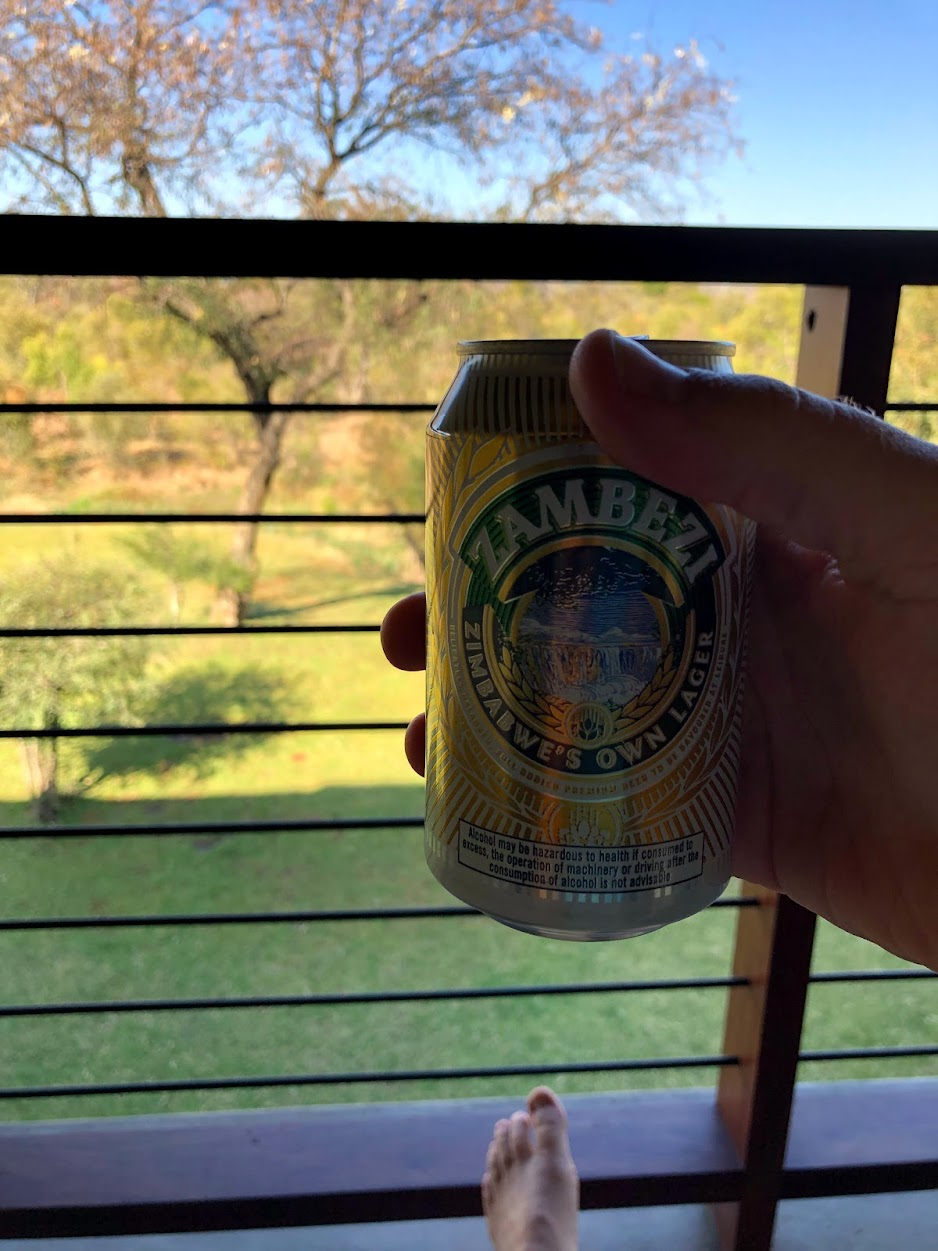
My room opens onto a veranda overlooking the bush, the mosquito net billowing like I’m starring in an aspirational perfume commercial. I step outside. A rainbow appears in the mist rising from Victoria Falls. Casually. As if nature says, “Here’s a complimentary serotonin boost.” I stretch out on the bed, staring at a landscape so peaceful I can practically hear my blood pressure lowering.

Warthogs wander the hotel grounds like they’re late to an HOA meeting. Everything feels wild and alive. Calm. Exactly what I need.
I pop open a local beer from the minibar and sit outside before heading to my evening dinner cruise on the river’s namesake—the Zambezi.
A driver picks me up and takes me to a dock where Vervet monkeys are the unofficial greeting committee.

I board the dinner cruise on the Zambezi River. It's the kind of day where the sunset is so absurdly perfect you start doubting whether the sky signed an exclusive sponsorship deal with Instagram.

I take my assigned seat at the edge of the boat, ready to contemplate life’s mysteries while eating safari snacks consisting of peanuts and corn and perusing the night's menu.

It’s one of those classic solo-traveler moments where the sunset is cinematic, the breeze is perfect, and every single person around me is either a couple or part of a cheerful group. I feel like I accidentally showed up to date night alone.
My quiet solitude is broken when the boat staff points out several hippopotamuses surfacing like grumpy, half-submerged non-plussed submarines.

Then come the swimming elephants. Elephants, animals the size of a compact car and the weight of a studio apartment, moving across a massive river as if physics is just a suggestion. I had no idea elephants could swim, let alone use their trunks as snorkels. It’s ridiculous and adorable and somehow majestic all at once.

Dinner arrives after sundown, once the animals disappear into the darkness.
And then a group waves me over with an enthusiasm that leaves no room for polite decline.
“We’re with Friendship Something Church,” they say (not the actual name), all smiles. “Sit with us!”
You know that feeling when you suddenly realize you’re the only person at a party who missed the memo on the dress code? That’s me. They’re warm, laughing, passing snacks around like it’s a family reunion. And at the end of the table is the founder. A white woman from Oklahoma surrounded by black African congregants, speaking joyfully about the church.

It’s complicated. Sweet. Awkward. Historically thorny (to put it mildly). Heartfelt. Comforting and unsettling at the same time. I’m personally opposed to the idea of white people traveling to developing nations to spread religion. It feels like privileged people telling others how to live. The entire situation puts me on alert. It’s one of those travel moments that makes you sharply aware of your own place in the world while still feeling grateful to witness something sincere, even if your feelings about it are still sorting themselves out.
Yet they welcome me without hesitation, without politics, and without questioning why I look like the poster child for a malaria-pill brochure. By dessert, we’re all laughing under lantern light. I take a selfie, and one of the congregants jokes that phone cameras never pick up Black people well. I mention that photography was invented by white Europeans, and technology wasn’t designed with darker skin in mind, which still causes issues today.
“That’s not racism,” the church founder insists. “It wasn’t created intentionally that way.”

A million thoughts come racing at me simultaneously. Does racism have to be intentional? Or is this one of those cases where something invented in the 1800s by Europeans for Europeans simply reflected the worldview of its creators, never imagining it would one day be used by everyone everywhere? And is that distinction actually meaningful?
I keep those thoughts to myself and quietly hope the boat docks soon so I can slip out of this sticky, complicated moment.
Eventually we return to shore under a blanket of darkness. I climb into the waiting van, ride back to Ilana Lodge, shower off the river air, and collapse into my mosquito-netted bed. The whole day feels absurd in the very best way.
Maybe that’s the real punchline of this entire trip—a journey that starts with a Swiss Air Lines flight and ends with me tucked into a bed wrapped in gauze like a discount Victorian ghost. The universe didn’t hand me a tidy “work hard and dreams come true” narrative. Instead, it gave me a collage of mismatched scenes that somehow form a coherent whole: prestige paired with panic, discomfort with kindness, a solitary traveler beside a swimming elephant.
A newspaper article recognizing my work arrives on the same day I nearly get denied entry into a country because I don’t have the right cash. A sunset cruise meant for quiet reflection ends with me sitting alongside a group whose very existence challenges my ideas about belonging, purpose, and power. Life keeps handing me these moments where I expect to feel validated or inspired, but instead I get something stranger and far more human.
Maybe the award means I’m doing something right.
Maybe the church group means I still have things to unravel.
Maybe the river means the world is weirder, wilder, and more generous than I always remember.
But the through-line isn’t achievement. It’s humility. It’s the universe reminding me, again and again, that life is less about being successful and more about who you become in the awkward, unplanned, uncomfortable in-between moments.
If there’s a takeaway, it’s certainly not about being under forty.
It’s about being unfinished.
And maybe that’s the best news of all. You don’t grow from the curated milestones. They’re just headlines. You grow from the strange, uneven, misaligned footnotes you stumble into along the way.
Recommendations
After a day spent tracing the rim of Victoria Falls, let the experience continue where the river slows and the light softens. A Zambezi River sunset cruise offers a quieter perspective on the landscape, with glassy water catching the sky’s changing colors and wildlife appearing at the river’s edge. It’s an unhurried way to appreciate the region’s beauty—hippos surfacing between reflections, palm silhouettes sharpening against the horizon, and the sun disappearing with cinematic precision. (I booked through this excellent operator: https://gyg.me/86WoNifQ.)
For a stay that matches the destination, Victoria Falls Hotels Ilala Lodge Hotel provides understated luxury just steps from the park. The property blends warm hospitality with refined comfort, offering rooms with crisp linens, tranquil gardens, and the occasional visit from grazing wildlife. Its calm, contemporary atmosphere creates the perfect contrast to the roar of the falls—an ideal base for returning each evening with a camera full of memories and a mind still full of mist. Highly Recommend.
If you’d like to support my work, you can bring home one of the images I captured along the way.

Comments