Things to do in Zurich on a Layover or If Beyoncé Were a Clock, She’d be in Switzerland

My Zurich layover story started, as these things often do, with a minor existential crisis and a slightly major health scare I refused to properly acknowledge because of a lack of boundaries and an overactive work ethic. Toss in notification from a public speaking experience, some PTO I hadn’t touched in years, and a desire to find some peace, and you’ve got the perfect conditions for spontaneous international travel. The plan? Loosely: find the world’s happiest animal on an island off the west coast of Australia - the quokka. The method? Complicated and deeply reliant on airline miles.

And so begins the game of “How Close Can I Get to Perth Using United's Airline Miles?”—a game not unlike Jenga, if the blocks are held together by complicated airline alliances and decision-making based on simply needing to get away from people that stood you up at the gala and are too embarrassed to speak to you after doing so.
The answer, naturally, is Africa. Specifically, Victoria Falls, Zimbabwe. From there, the least expensive route to Western Australia wouldu lead me through Mauritius—an island I’d never heard of but would soon learn was the former home of the dodo bird, which, like most noble creatures, was wiped out by human curiosity and bad manners.

Within ten days of spontaneous flight-hunting, I had stitched together a three-week itinerary that would take me around the globe, brushing against five of the seven continents. Why not? I already had all the vaccines. And a dwindling grasp on my emotional wellbeing. It seemed like as good a time as any.
The day of departure arrives. I board a United Express puddle jumper from San Luis Obispo to LAX, then prepare to hop across the Atlantic On a Swiss International Air Lines flight with a 12-hour layover in Zurich, Switzerland—a city I chose for no reason other than I’d never been and the thought of visiting a place where people organize their Tupperware by size sounded nice.
My layover in LAX kicks off with a long, unsettling walk through what I can only describe as the airport’s intestinal tract—corridors so desolate I begin to wonder if I’m in the right place or just trapped in some Kafkaesque purgatory beneath the runways. Eventually, I emerge from a pair of double-wide doors and am relieved to find myself inside Tom Bradley International Terminal, where I immediately reward my perseverance with wine and Star Alliance lounge food. It will be the last time I eat something that isn't either international or unidentifiable for several weeks.
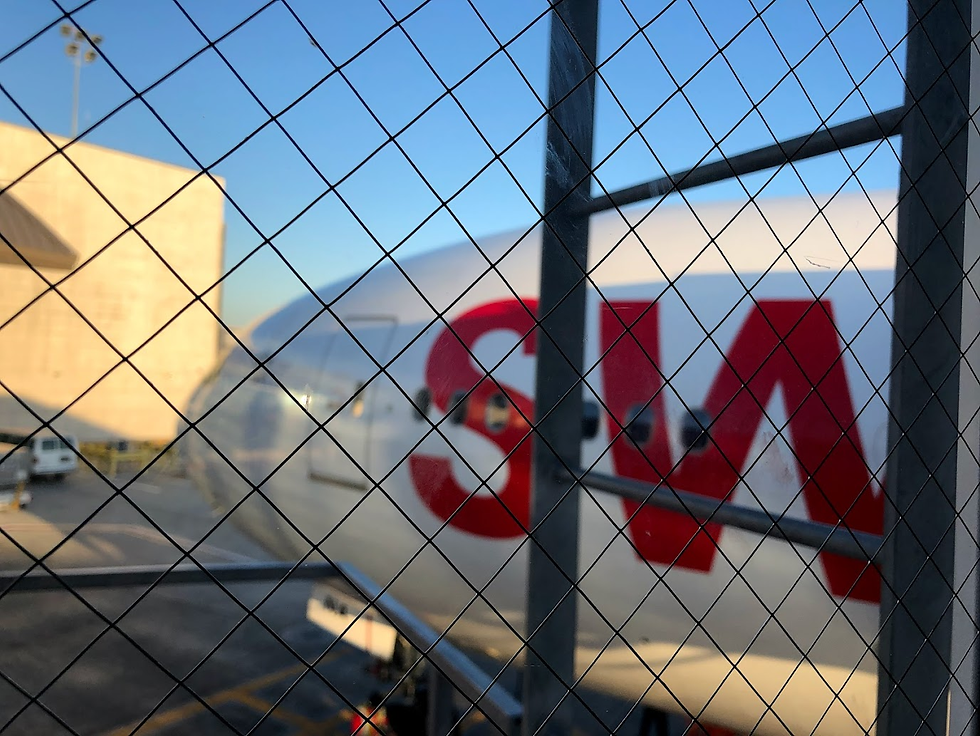
When it’s finally time to board my Swiss Air flight, I learn a few important things in roughly 24 hours:
Switzerland’s economy, while robust, is not built entirely on Ricola cough drops, chocolate, pocket watches, or selling copies of the Heidi book series to my dismay.
Zurich’s public transportation is far less intimidating than it looks on Google Maps.
I am brave. Also, awkward. But mostly brave (depending on who you talk to).
Choosing what not to pack and carry into the next chapter of your life requires trial and error.
My layover plan, such as it was, had me storing my carry-on at the airport, taking a train into the city to meet a walking tour guide, then grabbing dinner with a friend of a friend before catching my overnight Swiss Air Lines flight to Johannesburg and, eventually, to Victoria Falls on South African Airways.
After a night filled with a caprese salad and the kind of sleep you get when people keep grazing your arm with their butts and the beverage cart doubles as a battering ram, I wake up to coffee, and a surprisingly edible airplane breakfast of a pastry and a bowl of scrambled eggs and sausage. The view is very much what I imagine from Heidi: Her Years of Wandering and Learning, except I’m the one wandering, and the only thing I’ve learned so far is how grateful I am for coffee. Switzerland is so green and storybook it practically shouts, “This is where Heidi owns property and would have a yoga goat AirBnB experience if she were alive today”
A refined in-flight dining experience aboard Swiss Air featuring a tomato and mozzarella appetizer, Swiss Air breakfast service featuring a spinach and cheese omelet with sausage, fresh fruit, pastry,
Upon landing, I switch off airplane mode and receive a chipper text from Kirill, the walking tour guide I booked during a late-night haze of optimism on GetYourGuide.com.
“Hey Doug, it’s Kirill from LocalBini. You’ve booked a city tour starting today at 5pm at Limmatquai 55. Is this still okay for you?”
Somewhere in the fictional afterlife of classic literature, I imagine Fräulein Rottenmeier—the grim, city-dwelling governess who tried to stamp out Heidi’s spirit with strict rules and zero sense of humor bristling at the informality of it all. A tour guide with first-name friendliness? Plans made via text message? Scandalous.
Still mildly delirious and trying to navigate a foreign airport among a crowd rushing of an international flight, I reply: "Hello. I think 5 is still good. I just landed at the airport. I'm hoping to find a luggage locker and then take an Uber to meet you.”
“Perfect,” he texts back. “There are lockers at the main train station in the city center (Zürich HB/Hauptbahnhof). I can also meet you at the train station instead of Limmatquai, if you want. FYI, Limmatquai is around 15 min on foot/5 min by car from the main train station. I'll be waiting for you at Limmatquai 55 in front of the door with the golden lions at 17:00. I’ll be dressed in all grey and holding a piece of office paper. :)”
While I appreciate Kirill’s meticulous instructions and emoji optimism, the details are mostly wasted on me and I keep re-reading them hoping they'll make sense. I don’t quite understand what Limmatquai is, or how it differs from the train station, so I’m glad I can outsource this particular problem to an Uber driver. All I need is someone with a functioning GPS and a willingness to deal with me in their back seat.
Local time is currently 16:20. Zurich, ready or not, here I come.
I wander through the Zurich airport and am struck by how much smaller it is than I imagined—efficient, yes, but far from the sprawling behemoth I’d expected from a country famous for precision. The luggage storage room is exactly where the internet said it would be, which feels like a small victory. I hand off my camera backpack and rolling carry-on to a no-nonsense man behind the counter who looks like he’s been guarding luggage since the Reformation, then locate and ATM and take out 100 Swiss francs, for no other reason than I feel like I have no idea what I'm doing and should have cash.
Outside, I call an Uber to what appears to be the city center. There’s immediate sticker shock—about $65 (in 2019 dollars) for the ride—but I’m too tired to fight with public transportation and too introverted to ask anyone for help navigating it.
The car is silent. The driver is silent. I am also silent. We travel through what seems to be a well-organized postcard, and eventually he drops me off at Limmatquai 55. Much like the airport, Zurich itself is more compact than expected—less international finance hub, more fairytale village who's side hustle is banking.
Limmatquai 55 turns out to be a stone building that looks vaguely turn-of-the-century-bank-ish, but I don’t see any golden lions, per Kirill’s instructions. I’m a few minutes early, so I decide to wander a bit, carefully dodging an onslaught of mission-driven pedestrians and alarmingly fast bicycles.
After circling the block and briefly questioning my sense of direction and/or grip on reality, I spot two small golden lions flanking a doorway of the stone building. Ah. The lions aren’t a landmark so much as an afterthought in building design. I lean against the wall, jet lag creeping into my bones, and begin nodding off like someone who’s been awake for far too long and made far too many decisions without sleep.
Just as I’m contemplating a nap against the side of a Swiss financial institution, I look up and see a tall, handsome man walking toward me. He looks like he could play on a European soccer team or possibly model for expensive watches.

“Hallo. My name is Kirill,” he says with an accent that’s not quite Swiss-German but polished enough to feel vaguely cosmopolitan. I immediately go inward. I’m exhausted, and I’m paying this man to walk me around a city that's probably less dangerous than a day at Disneyland, which feels somewhat ridiculous.
“What would you like to do this afternoon?” he asks. It’s a fair question. One I probably should’ve considered before arriving. Normally I’m more prepared, but the recent drama I'm escaping has left me spiritually damp and mentally frayed.
We begin walking along the Limmat River in Old Town Zurich—Switzerland’s largest city, which still feels surprisingly small.
“What do you do for work?” Kirill asks.
“I manage a museum.”
“Oh? What kind?”
“Natural history. Mostly archaeological material.”
His eyes light up. “Then I know exactly where to begin our walk.”
He picks up the pace, and I trot after him as he begins narrating Zurich’s Roman past. Originally known as Turicum, the city began as a customs station on the Limmat, a link in the trade chain between Italy and Gaul. Over time, that little outpost became a cultural and economic powerhouse—though you wouldn’t know it today, walking through its cobbled streets that feel more like a perfectly preserved diorama than a place where revolutions were once whispered into steins of beer.
We arrive at Thermengasse, the site of Zurich’s ancient Roman baths—discovered in 1983 and now integrated into the public alleyway and the basements of surrounding shops and residences. They’re protected by a metal grating and, like most things in Zurich, impossibly clean. Kirill explains how Zurich has chosen to preserve its heritage in situ, literally building its modern life around fragments of the past—like a city that’s both living and quietly time-traveling.
A lone bicycle rests under an exhibit explaining the science of water Zurich’s Roman baths—because nothing says ancient history like walking your bike right over it.
We continue our walk through Zurich, which is already winding down even though it’s only around 5:30 p.m.—the kind of city where nightlife seems to involve orderly queues and early bedtimes.
We pass the Grossmünster, a Romanesque-style Protestant church whose twin towers dominate the skyline. Legend has it Charlemagne discovered the graves of Zurich’s patron saints, Felix and Regula, on this site and ordered the church’s construction. The Grossmünster would later become the epicenter of the Swiss Reformation, led by Huldrych Zwingli in the early 1500s. Today, you can climb the towers for panoramic views of the city or contemplate the magnitude of religious reform, depending on how many stairs you’re willing to face.
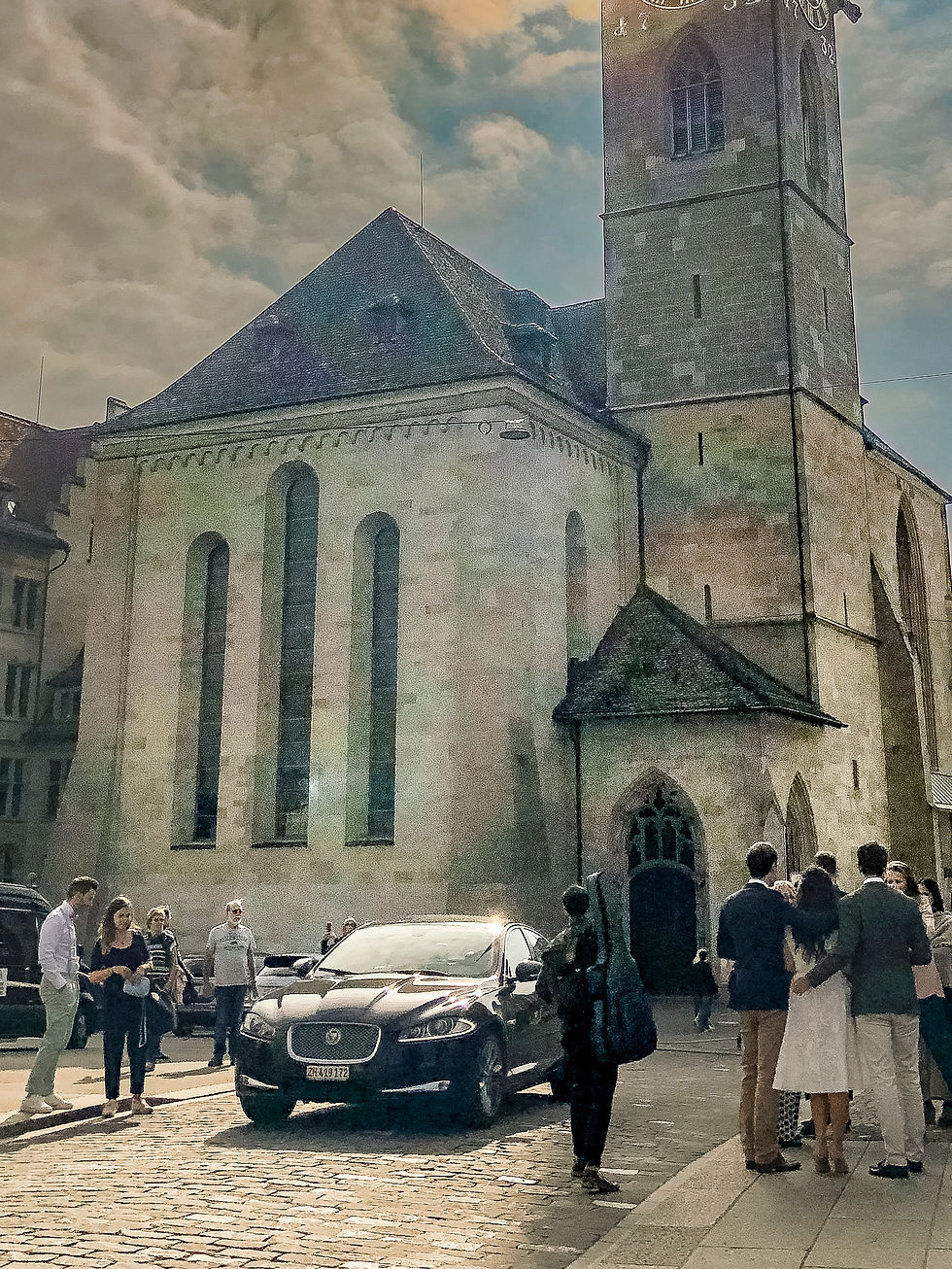
A few cobblestones away is another architectural standout: Fraumünster Church, instantly recognizable by its slender green spire rising from the left bank of the Limmat. Originally founded in the 9th century as an abbey for aristocratic women (because Zurich has always been ahead of the curve), it’s now best known for five glorious stained-glass windows designed by Marc Chagall. Installed in 1970, each window is dominated by a single color and depicts biblical scenes in that gauzy, dreamlike way only Chagall could pull off. No photos allowed inside. And the outside? It looks like it might also be a post office. But seems to be how Zurich operates—understated on purpose.
As we stroll past shuttered windows and slightly judgmental medieval façades, we round a corner and—oh, hello—St. Peter’s Church.
Zurich isn’t a city that flaunts. It irons its socks, labels its dry goods in three languages, and probably composts better than you. But the clock face on St. Peter’s? That thing is showing off. At 8.7 meters across, it’s the Beyoncé in Cowboy Carter of timekeeping. The largest church clock face in Europe, it looms over the city with the quiet confidence of someone who knows they run things. Less a way to tell time, more a statement piece, it feels like the result of a bet among 18th-century clockmakers: “Let’s make a timepiece so large it shames tardiness into submission.” *said in a thick Swiss-German accent

Kirill assures me the clock isn’t just decorative. “The Swiss like to be on time,” he says, in a tone that reads as both cultural insight and gentle warning.
These landmarks—part grand, part understated—sum up Zurich beautifully. It’s a city where contradiction is the aesthetic: modern and ancient, daring and discreet, scolding you for jaywalking while quietly preserving Roman ruins under your feet.
Here, the past and present don’t clash. They hold hands. They share a schedule. And naturally, they’re both on time.

We continue wandering through Zurich’s Old Town, nearly missing in front of a squat little building that Kirill decides to turn around and point out, with a name that sounds like it would host vaudeville acts more so than revolutionaries—or possibly revolutionary vaudeville: Cabaret Voltaire.
There it sits, modest and unassuming, like history wearing an overcoat two sizes too big. A small plaque clings to the wall beside the door, doing its best to be polite about the fact that this was, once upon a delirious moment in 1916, the birthplace of Dadaism—the wild, absurd, glorious middle finger to logic, war, and all the self-importance that Europe was practically hemorrhaging at the time. The movement that once decided that a urinal signed, "R. Mutt" was a piece of art and that nonsensical words were poetry.
The street is quiet. No trumpets of artistic rebellion, no poets in monocles shouting manifestos into the night—just the low hum of a city that has long since buttoned itself back up. And yet, standing there, you can almost feel the absurdity still echoing off the cobblestones. Of course a group of exiles would invent nonsense here. Of course they’d craft meaning out of chaos while the rest of the world burned—because the most meticulously organized place on Earth is, naturally, the most ironic stage for a movement built on disorder.
And then we walk on—because that’s the thing about places like this. They don’t demand your attention. They’ve already changed the world. Now, they simply wait—for the curious, the wandering, the ones still listening for echoes.

We round a quiet corner in Zurich’s Old Town when Kirill—my guide, who until now has been diligently narrating the finer points of 14th-century façades—suddenly gestures toward an unassuming building and says, almost offhandedly, “This was once the club venue for Der Kreis, the world’s first gay and lesbian club. Very influential.”
I pause and wonder. Is Kirill remarkably well-versed in LGBTQ history? It throws me. I prepared myself to travel to African nations that put people in that community to death. I wasn't thinking about countries where people were actually free to be themselves. I’m pretty sure he catches the flicker of surprise on my face.
I learn that, from 1948 to 1960, this modest spot that is now home to the Theater am Neumarkt, was Eintracht, the club venue for Der Kreis (The Circle), a pioneering organization that, between 1943 and 1967, quietly reshaped gay and lesbian life across the Western world. At a time when being openly gay could destroy or end a life everywhere on Earth, Der Kreis fostered community, published a daring magazine, and hosted dances that pulsed with quiet resistance.
It’s the kind of revelation that makes you wonder how many revolutions are tucked between bakery signs and historic plaques. And Kirill? Still very much an enigma.
We walk back toward the bridge, ducking under a tree-lined promenade, pausing to watch people feed what appear to be swans. I wouldn't be surprised if they were geese and I'm just unfamiliar with large waterfowl.

Eventually, it’s time for Kirill and me to part ways so I can meet a friend-of-a-friend for dinner. It’s an awkward moment beside the Zurichsee. Kirill has a look I can’t quite decipher, and I’m not entirely sure how to say goodbye. I enjoyed his company—and I think he enjoyed mine, given we talked the entire afternoon. But now he’s standing unusually close, and I can’t tell if he’s expecting a tip. I’m unprepared for either: I was told tipping isn’t customary here, and I don’t have any small bills anyway. So, I do what any emotionally stunted jet-lagged introvert would—I shake his hand, thank him sincerely, and head toward the restaurant, hoping he doesn’t think I’m a cheapskate.
Still avoiding Zurich’s public transportation like its New York's subway on New Year's Eve, I summon another comically expensive Uber to meet Madeline, a friend of someone I know, at The Artisan Kitchen and Urban Garden. She’s done her homework. Knowing I enjoy obscure wine varietals, she greets me with a bottle of Arneis, a white grape once nearly extinct and now making a quiet comeback. Native to northern Italy and found in pockets of Switzerland, Arneis carries delicate floral notes and hints of stone fruit. Its cool, crisp finish is the perfect counterpoint to the still, surprising warmth of a Swiss August—like a breeze off the Alps, bottled and chilled.
We decide to pair the Arneis with an appetizer of brown sugar–glazed pork belly bacon, because if you’re going to toast new friendships, do it with something unhealthy and decadent. I opt for a salad as my entrée—my last hurrah with raw vegetables before heading to Africa, where I’ll be avoiding anything washed in local water like it’s a dare. Madeline goes all in and orders a burger.

While we wait, we savor the crisp floral notes of the Arneis and swap stories. I learn that Madeline once lived on California’s Central Coast—my own stomping grounds—for several years, where she worked in the wine industry and, in a very small-world twist, became close with people in the same orbit I now socialize in. Which explains how two near-strangers from different continents ended up in a gastropub in Zurich with an obscure bottle of white wine and plenty to talk about.
The food arrives, and it does not disappoint. The pork belly bacon arrives first, and it’s more sculpture than appetizer—thick, glistening ribbons lacquered with a brown sugar glaze so glossy it reflects light like a caramelized mirror. The edges are crisped to a near candy shell, while the centers remain tender and rich, like the culinary lovechild of barbecue and dessert. Each bite is smoky, sweet, sticky, and unapologetically indulgent. It’s not bacon for the faint of heart—it’s bacon for those who believe food should come with a warning label and a fan club. I'm so excited for this splurge that I take a photo. My chicken and salad, in contrast, looks like… a salad. Competent and leafy. I do appreciate the amount of fresh greens on my plate. However, Madeline’s burger, on the other hand, is a towering masterpiece of grilled perfection, oozing cheese and crowned with crisp onions and house-made sauce that smells like culinary ambition.
Several glasses of wine later, we’re snapping selfies, messaging our mutual friend back home, and chatting like we’ve known each other far longer than an hour. And then—just like that—the night evaporates. A part of me is reluctant to say goodbye. I’m heading off solo across the planet for a few weeks, and walking away from a warm, familiar face feels a bit like stepping off the edge of something. But this trip is something I’ve long wanted—needed, really—and the thrill still outweighs the nerves. After all, I was just named one of Pacific Coast Business Times’ 40 Under 40, and I’d declared Victoria Falls my bucket list destination for tens of thousands of subscribers. Time to put my miles where my mouth was.

Madeline walks me to the nearby light rail station and promises it’s cleaner, faster, and easier than I’ve given it credit for. She’s right on all counts. The train is quiet, spotless, efficient—and, at a fraction of the cost, puts my earlier Uber habit to shame. Do I feel slightly ridiculous for having avoided it all day? Of course. Would I still take an Uber next time? Also yes.
Growth, after all, is a process.
Back at Zurich Airport, I retrieve my carry-on and camera backpack, breeze through security with the glazed-over efficiency of someone who’s now on their second day without proper sleep, and brace for the next leg: Zurich to Johannesburg, then onward to Victoria Falls. I board the Swiss Air flight and find my seat—the one I refused to pay extra to reserve—tucked precariously along the aisle. There's no barrier between me and the chaos of knees, elbows, and rogue beverage carts. It’s clear: I will not be sleeping tonight either.
The menu offers three options for the main course: beef, fish, or a seemingly random dish of South Indian coconut noodles. While I’m sure the fish and noodles are perfectly respectable in their own right, I'm not willing to test the olfactory limits of an enclosed cabin at 38,000 feet. I choose the beef tenderloin with wild garlic crust, chimichurri jus, and cherry tomato confit.

When the first coarse arrives, I don’t instantly recognize it from the menu’s promises. I'm not entirely sure which component is the Bündnerfleisch air-dried meat and which is the artichoke purée, but it’s all plated with the geometric precision of a Swiss timepiece. A petite salad with a thimble of balsamic dressing accompanies it, and a wedge of cheese rests beside a dark, dense slice of what I assume is the famed Swiss pear bread.

The main course arrives with a European mess hall appearance, though the lighting gives it the moody ambiance of food served under lighting at a disco.
The dessert—a dainty layered slice of apricot and vanilla with pistachio sponge—looks like the kind of thing you’d expect to see in a pâtisserie window, not 35,000 feet somewhere above Europe and Africa.

I sip another glass of wine and pick at a meal that feels both vaguely elegant and oddly institutional—though I’m not really hungry after indulging at the Artisan Kitchen. I pop some NyQuil and convert my seat into a makeshift bedroom for the night. Draping myself in a blanket, I don my eye mask in a feeble attempt at comfort, even as the aisle beside me seems to double as the Autobahn.

I reflect on the past 24 hours.
Switzerland wasn’t what I imagined. It’s not all Ricola commercials, Heidi, and precision timepieces—though everything is disturbingly punctual and organized. We don’t travel just to see the world. Maybe we travel to discover which parts of ourselves we’re finally ready to leave behind. The pieces that no longer serve us. The fears that soften under foreign skies. The parts that finally exhale somewhere between jet lag and wonder.
I came to Zurich expecting a layover. What I got instead were alleyway conversations where revolutions were once born, unexpected kindness on spotless cobblestone streets, and the familiar ache of being human—and alone—but not lonely.
Even with a graduate degree in history, I somehow forgot that Dada was born here. Which is mildly embarrassing, like forgetting your own birthday. I also never learned that Zurich quietly opened its arms to the LGBTQ community, offering sanctuary while much of the world looked away. That wasn’t in any of my textbooks.
And then there’s my own story.
I’ll never know what Kirill expected. But six years later, I still think about that hour, that handshake, that awkward maybe-it-was-a-tip moment. Which is to say: I still care about showing up and doing the right thing even though I forget sometimes. About being kind. About not waiting for the perfect itinerary to start actually living.
And maybe that’s the real reason we go anywhere: to come back just changed enough that even your own reflection feels unfamiliar enough that you notice when you’re making the same mistakes repeatedly. You pack lighter (or at least try to). You laugh at yourself more. You forgive slower. And maybe—you break a hundred-franc note to tip your guide, even if tipping isn’t customary and you’re convinced he might be part soccer player, part philosopher.
Because choosing what not to pack and carry into the next chapter of your life requires trial and error. Sometimes the only way to figure it out is to keep moving forward even if you're being bumped by snack carts every step of the way.
Notes:
If you're planning your own Zurich adventure and want to dig deeper than the guidebook, I highly recommend booking an experience through GetYourGuide. It’s a great way to connect with knowledgeable locals and uncover the city’s quirks, culture, and hidden corners—without having to Google “things to do on a Zurich layover” at 2 a.m. Plus, GetYourGuide is part of the Expedia Group family, so if you’re already using Expedia to book flights or hotels, you can keep all your travel planning under one umbrella—and maybe even rack up some rewards while you’re at it.
Zurich Layover Itinerary (8–12 Hours, No Stress Edition)
1. Zurich Airport (ZRH) → City Center
Why it matters: Zurich Airport is compact, efficient, and unintimidating. Store your carry-on here if needed, grab some Swiss francs if you like tangible reassurance, and head into the city.
Tip: Public transit is excellent (even if you briefly pretend it isn’t).
2. Limmatquai
What it is: A picturesque riverside street running through Zurich’s Old Town.
Why stop: It’s the perfect orientation point—historic buildings, water views, and easy walking access to nearly everything worth seeing on a short visit.
3. Zurich Old Town
What it is: A compact medieval core filled with cobblestone streets and layered history.
Why stop: Zurich’s past doesn’t shout—it whispers. Old Town feels more like a living diorama than a museum, which makes wandering feel intimate rather than overwhelming.
4. Thermengasse
What it is: Remains of Roman baths discovered in 1983, preserved in place beneath modern buildings.
Why stop: A perfect example of Zurich’s quiet brilliance—Roman ruins integrated into daily life, reminding you the city has been reinventing itself for 2,000 years.
5. Grossmünster
What it is: A Romanesque church with twin towers dominating the skyline.
6. Fraumünster
What it is: A former abbey turned church, famous for Marc Chagall’s stained-glass windows.
Why stop: Inside is dreamlike color and quiet reverence; outside is deceptively plain. Zurich excels at underpromising and overdelivering.
What it is: Home to the largest church clock face in Europe.
Why stop: Less a clock, more a civic flex. A reminder that punctuality here isn’t a suggestion—it’s a cultural value.
8. Cabaret Voltaire
What it is: The birthplace of Dadaism in 1916.
Why stop: Revolutionary absurdity was born here—proof that even the world’s most orderly city occasionally snaps and invents nonsense as protest.
What it is: Former meeting and club venue for Der Kreis, the world’s first gay and lesbian organization.
Why stop: A quiet but powerful landmark of LGBTQ history, where community and resistance flourished long before it was safe to do so.
10. Lake Zurich (Zürichsee Promenade)
What it is: A serene waterfront escape minutes from Old Town.
Why stop: Watch swans (or possibly geese) being fed, breathe deeply, and let your nervous system catch up with your body.
What it is: While you can't enjoy dinner with my friend, you can meet others by clicking the link above.
Why stop: It's necessary to connect with other humans.

Comments