Elephants, Empire, Running from an Artist, and Very Human Mistakes: Things to Do in Victoria Falls
- Doug Jenzen
- Jan 22
- 17 min read
Updated: Jan 22

But First, Some History
This is a story about systems and the people and animals who live inside them. About confidence mistaken for competence, and sometimes the reverse. About decisions made far away and paid for up close. And about the strange clarity that emerges when history, guilt, and grace all occupy the same afternoon.
When I arrive in Zimbabwe, I don’t yet recognize what I’m carrying. What I feel instead is a faint, inherited confusion, the kind that comes from growing up with maps that changed the year I was born, borders redrawn quietly while no one asked children to consider what that meant for the people living on the ground. I come as a visitor, curious and well-meaning, armed with history I’ve half-learned and assumptions I haven’t yet questioned. What I don’t expect is how quickly abstraction gives way to consequence, how empire, independence, conservation, and economics stop being concepts and begin appearing as moments I can’t unsee... experiences that reshape how I understand the world and my place within it.
This place was once called Rhodesia, which, as a plant person, sounds vaguely botanical until you learn it was named after Cecil Rhodes, a man who believed geography was most useful when it could be acquired, renamed, and leveraged for profit. Rhodes didn’t stumble into this part of Africa by accident, nor was it simply absorbed into South Africa by imperial gravity. It was taken deliberately, through contracts signed under duress, a private army, and a corporation with a flag. Rhodes was not a government official so much as a venture capitalist with imperial ambitions. Through the British South Africa Company, he secured a royal charter that allowed him to administer vast territories north of the Limpopo River as a kind of for-profit colony. This is why the land that would become Zimbabwe was never folded into South Africa proper. It wasn’t governed by London or Cape Town in the usual way. It was owned. Managed. Monetized. Rhodesia existed less as a nation than as a balance sheet.
This was part of what we learned was called the Scramble for Africa in U.S. secondary school.

The original British justification for all of this leaned heavily on the mythology of “discovery,” much of it inherited from figures like David Livingstone, who famously encountered Victoria Falls and promptly renamed them after his queen because if there’s one thing empire excels at, it’s mistaking first European sight for first existence.
Livingstone and Rhodes never worked together, but the stories Livingstone helped popularize... the idea of an empty, waiting Africa in need of European guidance, created the moral scaffolding Rhodes would later climb. Exploration softened the ground and extraction followed. What that narrative conveniently ignored was that none of this land was empty, and none of its history began with Europeans. Long before colonial borders hardened into straight lines, the region was home to powerful African civilizations, notably the Great Zimbabwe. Between the 11th and 15th centuries, its stone cities functioned as political and economic centers, linked through trade to the Swahili Coast and the wider Indian Ocean world. These were not provisional settlements or historical placeholders awaiting Europe’s arrival. They were enduring, sophisticated societies with architecture so precise it required no mortar. The ruins still stand, vast granite walls rising from the landscape, quietly contradicting the colonial claim that civilization needed importing.

After World War II when the world began to realize that colonialism and empire didn't work, the damage had already been carefully itemized and filed away. Queen Elizabeth II inherited Rhodesia as both a legal problem and a moral one. As a constitutional monarch, her power was real but narrow. She could withhold legitimacy, refuse recognition, insist on process. She could not force justice to arrive on schedule. When Rhodesia’s white-minority government declared unilateral independence in 1965 essentially attempting to freeze colonial privilege in place, Elizabeth rejected it outright. Britain imposed sanctions in her name. On paper, Rhodesia ceased to exist. On the ground, it continued anyway.
Independence, when it finally came in 1980, arrived with both ceremony and exhaustion. Rhodesia became Zimbabwe, reclaiming a name rooted not in ownership but in history. The flag changed. The anthem changed. The systems beneath them proved far more resistant. Economic structures, environmental management, and bureaucratic habits remained largely intact.
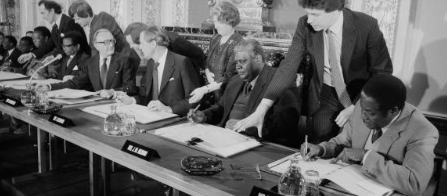
Decolonization, it turns out, is excellent at resolving constitutional questions and far less adept at repairing what's broken.
And history, like wildlife, does not respond well to management.
Colonial governance had long treated land as something to be optimized, and that logic survived independence. Zimbabwe’s national parks and conservation policies inherited the same instincts to count, control, and intervene. By the late twentieth century, the country faced a genuine ecological dilemma: large elephant populations confined to shrinking protected areas. The solution chosen was elephant culling, a phrase so antiseptic it almost reads as fiction. Complex, social, long-lived animals were reduced to numbers that could be adjusted until the balance appeared correct.
Robert Mugabe entered independence as both liberator and complication. A former schoolteacher turned revolutionary, he had spent years fighting the white-minority Rhodesian government through the Zimbabwe African National Union while the country endured a grinding guerrilla war. By the late 1970s, Rhodesia was economically strangled by sanctions, militarily exhausted, and politically untenable. Britain, eager to close one of the most unresolved chapters of empire, convened peace talks in London that led to elections and majority rule. Mugabe won decisively in 1980, presenting himself as a reconciler and promising unity and restraint. It was under these circumstances that Queen Elizabeth II hosted him, not as an endorsement of what would follow, but as a constitutional necessity.

Mugabe’s reign unfolded as a long, disquieting lesson in how liberation can curdle into repression. He governed first as a pragmatic nationalist, expanding education and health care and speaking the language of reconciliation, which bought him international goodwill and time. But power hardened quickly. In the 1980s, Mugabe ordered a brutal military campaign known as Gukurahundi that killed tens of thousands of civilians and made clear that dissent would not be tolerated. Over the decades that followed, elections grew increasingly manipulated, opposition was harassed or crushed, and the perception of state fused with Mugabe himself. Land reform, long delayed and badly needed, arrived chaotically and violently in the 2000s, collapsing agriculture and triggering hyperinflation so severe that money became a joke people carried in backpacks.
Mugabe ruled not because Zimbabwe failed to imagine something better, but because revolutionary legitimacy was repeatedly used to justify remaining long past the moment of trust. By the time he was finally forced out in 2017, he had become a symbol of one of the central tragedies of postcolonial history: that the end of empire does not automatically deliver justice, stability, or restraint. It offers only the opportunity for them, and even that can be squandered.
That same logic, authority narrowing complex lives into manageable problems, did not stop with people. It extended outward into land and wildlife, where decisions were framed as necessary, technical, and unavoidable. Elephant culling followed this reasoning. Populations were reduced to numbers. Ecosystems were translated into carrying capacities. Violence was rebranded as management. What the math could not account for were the consequences that never appear in policy memos: calves watching their mothers die, herds unraveling, trauma embedded in memory and behavior. Like colonial borders, these decisions were made by people who would never live with the aftermath.
It was not cruelty so much as confidence. The same confidence that once assumed land could be renamed, nations reorganized, and histories overwritten without residue.
Independence did not end these patterns. They persisted in landscapes shaped by extraction and reform, in political institutions asked to carry impossible expectations, and in elephants who outlived the policies that orphaned them. Decades later, those elephants would walk beside tourists near Victoria Falls, their presence quietly insisting that history is not finished simply because the paperwork says so.
That is the point where the story stops being abstract. Where monarchy, empire, independence, and conservation theory collapse into something immediate and physical. Where I finally enter the frame as someone standing beside history's consequences, resting a hand against the rough hide of an elephant named Jumbo, trying to understand what survives when systems move on and lives do not.
An Afternoon with Elephants

I have lunch at Ilala Lodge mostly because it's excellent, but in all honesty it’s easier—the kind of practical decision you make when you’re traveling alone and don’t feel like turning find a restaurant into a competitive sport even when there is a plethora of good local restaurants available according to TripAdvisor. Afterward, I wait out front by the lobby, in the familiar pickup spot that has started to feel like choreography and with it, the quiet promise that we’re heading just outside town, into a private stretch of bushveld.
The guides are funny in that dry, lightly irreverent way that signals competence—you laugh because you trust them and one of them is carrying a large stick with a hook on it. The visit doesn’t begin with a dramatic reveal so much as a gradual unfolding: introductions, context, stories delivered with the ease of people who know these animals as individuals rather than attractions.
We meet Jumbo first, as if there’s any chance of confusing him with someone else. The guides share a steady stream of information about elephants—how they think, how they move, and how we should conduct ourselves to avoid startling Jumbo and turning a pleasant afternoon into international headlines. One by one, we take turns touching him and having our photos taken. It’s a moment that requires me to step outside my comfort zone, asking strangers if they’ll take my picture—an awkward but necessary ask when you’re the only one flying solo on the tour and no one else is extroverted enough to introduce themselves first.

We set off on a trek through what they cheerfully call elephant food: a stretch of bush so aggressively thorned it looks less like a snack and more like a dare. I fall to the back of the group—an easy place to end up when you’re traveling alone—and the quiet suits me. It’s peaceful. One of the guides, Manda, suddenly photobombs a selfie I’m attempting to take, which is a welcome interruption. I feel completely ridiculous taking selfies and, frankly, it’s not a strength of mine. Out here, on foot, I start noticing the thorned plants around me in a way I haven’t been able to before—every other encounter with this landscape has happened from the safety of a jeep. I stop and snap a photo. The joke, delivered perfectly, is that elephants love this stuff precisely because it fights back. Watching Jumbo wade in—unbothered, methodical, entirely unconcerned with discomfort—feels like a lesson disguised as a punchline. The more intimidating part of this scenario, Jumbo, is actually the least threatening aspect given how vicious the plants appear to be.

Manda then makes a point of identifying elephant dung so that I avoid stepping in it, which looks exactly like horse poop, if your horse were the size of a garbage truck. This is presented as humorously useful information, which it probably is, though I can’t immediately imagine the scenario where I’ll need to confidently distinguish plants that an elephant digested. Still, there’s something grounding about it. History, empire, trauma, survival... eventually it all reduces to digestion. Even the largest land mammal on Earth leaves behind evidence that it was here, moved through, ate something sharp, and carried on.


Later, in a communal feeding area, we take turns tossing pellets directly into the mouths of the smaller elephant family members. They smell slightly of pellets one might feed their pet rabbit.
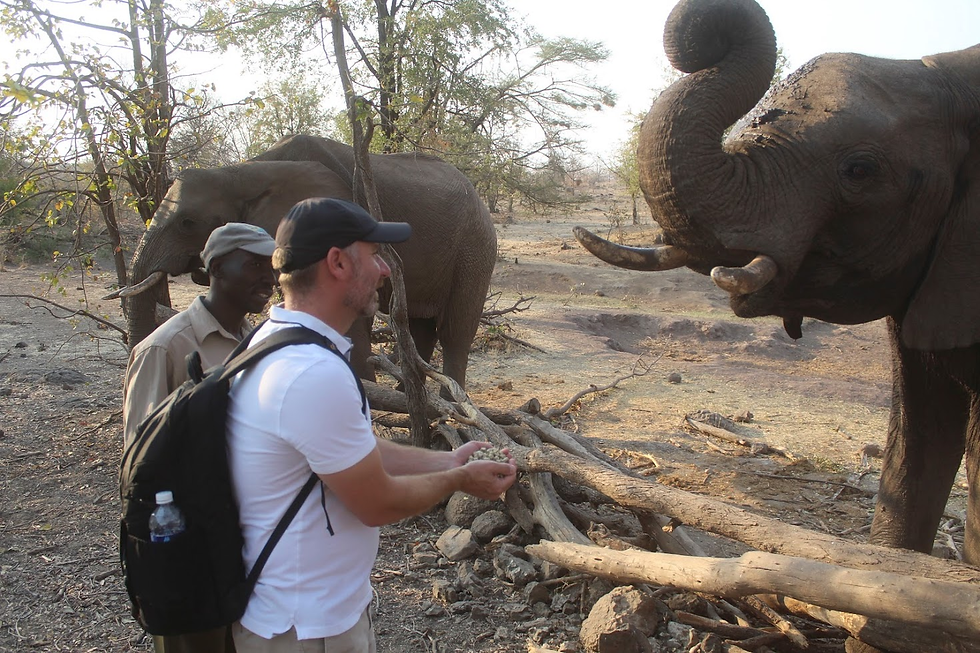
What surprises me most is the mood of the group. It’s joyful, unmistakably so, but also hushed—polite, reverent, as if we’ve all silently agreed that loud enthusiasm might cheapen the moment. Even afterward, at the post-trek reception, the quiet lingers. People sip politely. Conversations stay low. I order a local beer. Zambezi Lager, crisp and unpretentious, and quickly realize I’m the only one drinking. It doesn’t feel awkward so much as observational, like noticing you’re the only person clapping at the wrong tempo. Not necessarily a bad thing, I suppose.
There’s elephant art for sale. Large, exuberant canvases and enormous circular prints made from footprints dipped in paint. I linger longer than I expect, weighing the urge to support the program against the very practical question of what, exactly, one does with a giant painted elephant footprint once it’s back home. It feels like the most human dilemma imaginable: wanting to honor something meaningful while also imagining the conversation it would provoke on your wall. In the end, I leave empty-handed, carrying instead the quieter souvenir. Watching these enormous creatures move forward with such tenderness stirs something steady and ancient in me. It reminds me that healing doesn’t have to be fast to be real. Sometimes the most radical thing a survivor can do is simply keep showing up, one deliberate step at a time.
When I return to the hotel, it’s already dark. I stop to record the sound of birds chirping in a tree on the grounds, wanting something to carry with me after I leave Victoria Falls.
Next Day: Mistaken Timing, Crocodile, and Guilt

I wake early to pack, savoring the small comforts—the sugar biscuit and the oddly satisfying routine of wrestling with the three-dimensional triangular creamer. Biscuits, teabags, and packets of sugar are neatly laid out like an invitation by the Ilawa Lodge. Outside, the sun breaks across the horizon, casting a soft golden light over the bushveld and silhouetting the tree that's become a close friend over the last several days. I take my tea out onto the balcony, a steaming mug cupped between my hands, and watch the land wake up. A lone nyala grazes near the trees, barely making a sound.
There's silence settle around me, broken only by birdsong, and I try to feel unhurried.
In reality, I’m completely stressed out.
I take a deep breath. Then I do my best to pack a suitcase after living out of it for five days and three countries, attempting to compress chaos into something that will zip shut.
Ready for departure, I wheel my suitcase down to the front desk. The receptionist looks confused. "Sir, you're not scheduled to check out until tomorrow," she says kindly. "But we can change your reservation if you'd like to leave today." Mortified, I mumble something about being confused about the time difference and roll my suitcase back to the room. My day has a strange, dislocated feeling after that.
I walk to the hotel's restaurant and enjoy a large, deconstructed breakfast sandwich, then head back to my room to get work done given I now have a free day.

After tackling as many emails as humanly possible, I leave the familiarity of my hotel in search of food, guided, as so many travelers now are, by TripAdvisor. It leads me to a walkable spot called Zulu Café. I scan the menu posted on the wall, dense with wild game: impala, bushbuck, crocodile. When the waiter brings me a menu and waits, cheerfully expectant, I eventually point to the crocodile.
When it arrives, it looks vaguely like orange chicken. The taste is not far off either. Perhaps the everything tastes like chicken joke is less a joke than an evolutionary truth.

After lunch, I decide to look for souvenirs, specifically ones I can buy with a credit card, given my lack of cash and my inability to extract any from a bank. Once again, TripAdvisor comes to the rescue, directing me to a nearby shop. Inside, the shop assistant carefully wraps my selections: a small drum made from goat skin, and delicate animals woven from sisal, lacquered and impossibly light yet somehow resilient.
Everything is folded into newspaper printed with advertisements for, what I learn thanks to the internet is an anti-HIV medication from India.
Not knowing what sisal is, I ask. The shopkeeper explains that it is made from tree fiber. That is an environmentally friendly material I can support, I think to myself, and add a sisal giraffe to my pile, a modest gift to myself.
I walk back to my hotel, purchases in hand, a man on a curb on Victoria Falls' main street notices my branded shopping bag. He stands up from the curb and begins following me, shouting that I was supporting shops that exploited local artisans, that the markup for tourists was criminal because it doesn't pay locals. I try to explain—I have no cash. I had tried the ATMs, but they didn’t work. I repeat myself, louder this time. "You don't understand! I have no cash! Zero dollars!" Finally, he stops. His face softens, and he turns without another word. I walk the rest of the way in silence where I decide to work some more but ultimately end up drinking alone at the hotel bar.
Guilt hangs heavy. I want to support the artisans sitting on the curb, the ones running their own small shops, trying to claim agency within a difficult system. But the Zimbabwean economy hasn’t made that easy for me. That nuance, that invisible wall, isn’t obvious to those who live on the other side of it.
It’s never my intention to embarrass someone simply trying to make a living. And yet, apparently sometimes that’s how life unfolds anyway. There isn’t much you can do in those moments except carry the discomfort with you and tell the story honestly, so that others come better prepared, with cash in their pockets, when they visit Zimbabwe.
Next Morning: Departure to Mauritius
The following morning, I pack again and check out—this time for real. The shuttle to Victoria Falls airport is quiet, the scenery slipping by.
We pass the strange air traffic control tower that I've seen from pretty much every angle of Victoria Falls that doesn't seem to be located near the airport. I wonder if an older airport once stood closer to the Town.
By the time the plane lifts off, Zimbabwe has rearranged itself inside me. Not neatly. Not as a lesson with a moral you can underline. More like a collection of moments that refuse to be ranked while my brain tries to make sense of it all: a man shouting on a street corner about supporting locals, an orphaned elephant blinking slowly in the afternoon light, a mistaken checkout time, a meal of crocodile that tastes like chicken.
None of them cancel the others out. They coexist.
What stays with me is the recognition that limits matter. Monarchs have limits. Governments do. Conservation policies do. Travelers certainly do. Everyone is acting within the boundaries of what they can see, afford, justify, or survive. And the outcomes ripple outward, accumulating into something larger than intention.
I don’t leave Zimbabwe with answers. I leave with responsibility to remember what I witnessed, to tell it honestly, to admit my own small failures alongside the larger ones. Healing, I learned from elephants and from people, doesn’t announce itself. It’s slow. It’s uneven. Sometimes it looks like simply showing up again, carrying what you can, and resisting the urge to pretend the story is finished just because you’ve moved on.
I've made mistakes. And, the more mistakes I make, the more comfortable I am making mistakes.
Confidence doesn’t fix anything in the hands of the wrong people. But it fixes some things when the right people develop it.
Things to Do in Victoria Falls, Zimbabwe
A Thoughtful Travel Guide Beyond the Waterfall
Victoria Falls is often treated as a single attraction: arrive, photograph the mist, leave. But staying even a little longer reveals a place shaped by wildlife, history, and human consequence—where the most meaningful experiences happen when you slow down. These are the best things to do in Victoria Falls if you want context, depth, and moments that linger.
See Victoria Falls with Context, Not Just a Camera
A guided tour of Victoria Falls transforms the experience from spectacle into understanding. Rather than hopping viewpoint to viewpoint, knowledgeable local guides explain the meaning of Mosi-oa-Tunya, the geology of the gorge, and how colonial naming reshaped the narrative of the falls.
Why it matters: You don’t just see the waterfall—you learn what you’re standing in.
Good to know: Water volume changes seasonally. In drier months, the falls may be quieter, but visibility into the gorge improves.
Sunrise Safari in Zambezi National Park
A sunrise game drive into Zambezi National Park departs before dawn, when the landscape is still figuring itself out. This small-group safari prioritizes patience over spectacle, offering wide river views, remarkable birdlife, and subtle signs of larger animals passing through.
Why go: This is safari without pressure. You’re not chasing sightings—you’re observing a system waking up.
Good to know: Most tours include coffee, tea, and light snacks served along the river. Ideal for travelers who appreciate quiet mornings.
Walk with Elephants at Wild Horizons
The elephant experience at Wild Horizons is built around respect rather than performance. Guided by experienced elephant guardians, visitors walk through the bush at elephant pace, learning about behavior, conservation, and how to exist safely alongside animals that set the terms.
Why go: It’s not a show. It’s an education in restraint, trust, and humility.
Good to know: Elephants encountered here include orphans affected by historical culling policies. This context matters.
Take a Day Trip to Chobe National Park, Botswana
A day trip to Chobe National Park is one of the most rewarding excursions from Victoria Falls. Expect vast landscapes, slow-moving elephant herds, giraffes against open skies, and a guide who brings meaning to what you’re seeing.
Why go: Chobe delivers scale. It reminds you how large the ecosystem really is.
Good to know: Most tours include a lunch buffet and both land and river components.
Sunset Cruise on the Zambezi River
A Zambezi River sunset cruise offers a softer counterpoint to the roar of the falls. As the water stills, hippos surface, birds skim reflections, and the sky does most of the talking.
Why go: It’s one of the most peaceful ways to experience the region.
Good to know: Evening cruises are unhurried and ideal after a full day of activity.
Eat Adventurously at Zulu Cafe
Lunch or dinner at Zulu Cafe is one of the most memorable food experiences in town. Reviews consistently praise its relaxed atmosphere and menu that ranges from vegetarian dishes to traditional Zimbabwean game meat such as crocodile, kudu, impala, and guinea fowl.
Why go: It’s approachable, local, and unpretentious—a place where curiosity is rewarded.
Good to know: Located centrally in Victoria Falls town and easy to visit on foot.
Stay at Ilala Lodge Hotel
For accommodation, Ilala Lodge Hotel strikes a rare balance. It’s close enough to hear the falls at night, yet quiet enough to feel restorative. Wildlife wanders through the grounds, the rooms are comfortable without being fussy, and the restaurant consistently delivers thoughtful meals.
Why stay here: It allows the experience of Victoria Falls to settle rather than overwhelm.
Good to know: Ideal for travelers who value calm spaces after full days outdoors.
Half-Day Tour to Mosi-oa-Tunya National Park (Zambia Side)
A half-day excursion across the border into Mosi-oa-Tunya National Park includes iconic viewpoints like the Knife-Edge Bridge and the Boiling Pot, along with geological and historical context.
Why go: This tour emphasizes perspective—how rivers ignore borders, and landscapes outlast administration.
Good to know: Water levels vary by season, and wildlife sightings along the paths are possible.
Final Thought
Victoria Falls rewards travelers who resist urgency. The best things to do here aren’t about maximizing attractions, but about paying attention—watching light change, listening to guides who know the land, and allowing history and nature to coexist without forcing resolution.
If you come for the waterfall, stay for everything else.


Comments